
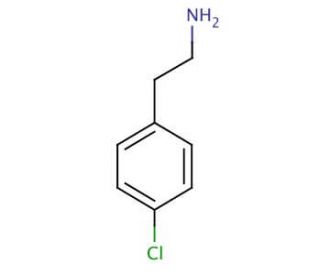

2-(4-Chlorophenyl)ethylamine (CAS 156-41-2)
QUICK LINKS
2-(4-Chlorophenyl)ethylamine is a compound that functions as a substrate in enzymatic reactions, as a precursor in the biosynthesis of various organic compounds. It acts as a building block in the synthesis of complex molecules, contributing to the formation of diverse chemical structures. At the molecular level, 2-(4-Chlorophenyl)ethylamine interacts with specific enzymes and proteins, participating in the formation of new chemical bonds and the modification of existing molecular structures. Its mode of action involves serving as a starting material for the production of more complex and diverse chemical entities, contributing to the development of novel compounds with potential applications in various fields. 2-(4-Chlorophenyl)ethylamine′s role in experiments involves its participation in chemical reactions and processes aimed at the creation of new chemical entities and the exploration of their properties.
2-(4-Chlorophenyl)ethylamine (CAS 156-41-2) References
- Responses of the silkworm tyramine receptor to 2-phenylethylamines and 5-phenyloxazoles. | Ohta, H., et al. 2005. Arch Insect Biochem Physiol. 59: 150-60. PMID: 15986379
- Structure-activity correlations for beta-phenethylamines at human trace amine receptor 1. | Lewin, AH., et al. 2008. Bioorg Med Chem. 16: 7415-23. PMID: 18602830
- On two novel parameters for validation of predictive QSAR models. | Pratim Roy, P., et al. 2009. Molecules. 14: 1660-701. PMID: 19471190
- Structure-activity relationship study of sesquiterpene lactones and their semi-synthetic amino derivatives as potential antitrypanosomal products. | Zimmermann, S., et al. 2014. Molecules. 19: 3523-38. PMID: 24662071
- Effects of the putative antagonists phaclofen and delta-aminovaleric acid on GABAB receptor biochemistry. | Robinson, TN., et al. 1989. Br J Pharmacol. 98: 833-40. PMID: 2556202
- A pyrazolopyran derivative preferentially inhibits the activity of human cytosolic serine hydroxymethyltransferase and induces cell death in lung cancer cells. | Marani, M., et al. 2016. Oncotarget. 7: 4570-83. PMID: 26717037
- Estimation of the Toxicity of Different Substituted Aromatic Compounds to the Aquatic Ciliate Tetrahymena pyriformis by QSAR Approach. | Luan, F., et al. 2018. Molecules. 23: PMID: 29695132
- The moonlighting RNA-binding activity of cytosolic serine hydroxymethyltransferase contributes to control compartmentalization of serine metabolism. | Guiducci, G., et al. 2019. Nucleic Acids Res. 47: 4240-4254. PMID: 30809670
- Catalytic Reductive Alkylation of Amines in Batch and Microflow Conditions Using a Silicon-Wafer-Based Palladium Nanocatalyst. | Sato, T., et al. 2020. ACS Omega. 5: 26938-26945. PMID: 33111021
- Dihydropyridine Lactam Analogs Targeting BET Bromodomains. | Jiang, J., et al. 2022. ChemMedChem. 17: e202100407. PMID: 34932262
- N-(2-Arylethyl)-2-methylprop-2-enamides as Versatile Reagents for Synthesis of Molecularly Imprinted Polymers. | Sobiech, M., et al. 2022. Polymers (Basel). 14: PMID: 35808783
- Syntheses and Structure-Activity Relationships of N-Phenethyl-Quinazolin-4-yl-Amines as Potent Inhibitors of Cytochrome bd Oxidase in Mycobacterium tuberculosis. | Hopfner, SM., et al. 2021. Appl Sci (Basel). 11: PMID: 36698770
- 1-(2-Thienyl)-2-phenylethylamines as potential non-stimulant anorectics. | Mrongovius, RI., et al. 1981. Arzneimittelforschung. 31: 1718-20. PMID: 7198448
Ordering Information
| Product Name | Catalog # | UNIT | Price | Qty | FAVORITES | |
2-(4-Chlorophenyl)ethylamine, 5 g | sc-254053 | 5 g | $35.00 |