
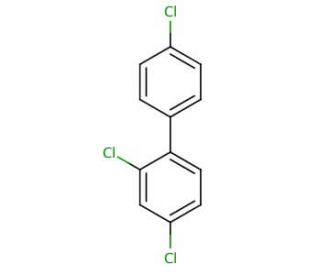

2,4,4′-Trichlorobiphenyl (CAS 7012-37-5)
QUICK LINKS
2,4,4′-Trichlorobiphenyl (TCB) is a synthetic, halogenated aromatic hydrocarbon widely utilized in the synthesis of various compounds. It is characterized as a colorless, crystalline solid. With its versatility, 2,4,4′-Trichlorobiphenyl finds applications in industrial synthesis, pharmaceuticals, and biochemistry. In scientific research, 2,4,4′-Trichlorobiphenyl has been employed in various capacities. It has served as a valuable component in the synthesis of pharmaceuticals, aiding in the production of drugs with diverse therapeutic properties. Furthermore, it has found utility in generating fluorescent dyes utilized in imaging and diagnostic applications. In the realm of biochemistry and physiology, 2,4,4′-Trichlorobiphenyl has been utilized to explore and understand the effects it imparts on biochemical pathways and physiological systems. Additionally, 2,4,4′-Trichlorobiphenyl has proven useful as a reagent in synthesizing other compounds, facilitating the creation of novel molecules in organic chemistry. It has also exhibited catalytic properties, enabling its utilization in organic reactions to enhance reaction rates and yields. The precise mechanism of action of 2,4,4′-Trichlorobiphenyl remains a subject of ongoing investigation. However, it is hypothesized that the compound functions as a modulator of certain biochemical pathways. Through interactions with enzymes and receptors, it is believed to regulate the activity of specific pathways involved in carbohydrate and lipid metabolism. Studies have indicated that 2,4,4′-Trichlorobiphenyl can influence gene expression related to metabolic pathways and impact the activity of certain hormones, further suggesting its involvement in biochemical modulation.
2,4,4′-Trichlorobiphenyl (CAS 7012-37-5) References
- 2,4,4'-trichlorobiphenyl increases STAT5 transcriptional activity. | Oakley, GG., et al. 2001. Mol Carcinog. 30: 199-208. PMID: 11346882
- [Effects of Rhizobium meliloti on PCBs degradation and transformation in solution culture]. | Xu, L., et al. 2010. Huan Jing Ke Xue. 31: 255-9. PMID: 20329548
- Automatic pH control system enhances the dechlorination of 2,4,4'-trichlorobiphenyl and extracted PCBs from contaminated soil by nanoscale Fe⁰ and Pd/Fe⁰. | Wang, Y., et al. 2012. Environ Sci Pollut Res Int. 19: 448-57. PMID: 21822927
- [Promotion effects of vitamin B12 on the degradation of 2, 4, 4'-trichlorobiphenyl by Nostoc PD-2]. | Liu, JY., et al. 2014. Huan Jing Ke Xue. 35: 3162-8. PMID: 25338394
- Removal of polychlorinated biphenyl congeners in mixture Delor 103 from wastewater by ozonation vs/and biological method. | Dudasova, H., et al. 2017. J Hazard Mater. 321: 54-61. PMID: 27607933
- Determination of the partition coefficient between dissolved organic carbon and seawater using differential equilibrium kinetics. | Kim, DY. and Kwon, JH. 2018. Environ Pollut. 240: 177-183. PMID: 29734078
- Effect of sulfonated graphene on uptake, translocation, and metabolism of 2,4,4'-trichlorobiphenyl in maize seedlings. | Ren, W., et al. 2018. Environ Sci Pollut Res Int. 25: 20084-20096. PMID: 29748797
- [Fate Simulation of 2,4,4'-Trichlorobiphenyl in the Bohai Rim Using the Multimedia Model]. | Zhang, Y., et al. 2020. Huan Jing Ke Xue. 41: 2625-2634. PMID: 32608777
- Dechlorination of 2,4,4'-trichlorobiphenyl by magnetoferritin with different loading factors. | Balejcikova, L., et al. 2020. Chemosphere. 260: 127629. PMID: 32698117
- Unraveling metabolic flexibility of rhodococci in PCB transformation. | Ines, P., et al. 2021. Chemosphere. 282: 130975. PMID: 34111638
- Toxic effects of 2,4,4'- trichlorobiphenyl (PCB-28) on growth, photosynthesis characteristics and antioxidant defense system of Lemna minor L. | Wang, C., et al. 2021. Plant Physiol Biochem. 166: 505-511. PMID: 34166977
- Tissue distribution, metabolism, and excretion of 2,4,4'-trichlorobiphenyl (CB-28) in the rat. | Moir, D., et al. 1996. Toxicol Ind Health. 12: 105-21. PMID: 8713718
- Subchronic toxicity of 2,4,4'-trichlorobiphenyl in the rat liver: an ultrastructural and biochemical study. | Singh, A., et al. 1996. Ultrastruct Pathol. 20: 275-84. PMID: 8727071
- Toxicity of 2,4,4'-trichlorobiphenyl in rats following 90-day dietary exposure. | Chu, I., et al. 1996. J Toxicol Environ Health. 49: 301-18. PMID: 8876656
Ordering Information
| Product Name | Catalog # | UNIT | Price | Qty | FAVORITES | |
2,4,4′-Trichlorobiphenyl, 25 mg | sc-238352 | 25 mg | $1040.00 |