
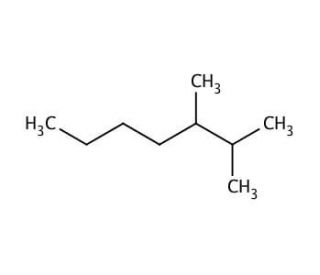

2,3-Dimethylheptane (CAS 3074-71-3)
QUICK LINKS
2,3-Dimethylheptane is chiefly utilized in research focused on hydrocarbon processing and combustion mechanisms. Its structure makes it a suitable model for studying the thermodynamic properties and reactivity of branched alkanes in fuel systems. Investigations involving 2,3-Dimethylheptane help in understanding how structural variations in hydrocarbons influence their physical and chemical behaviors under different conditions, such as temperature and pressure. This research is for developing more efficient and cleaner burning fuel formulations. Furthermore, 2,3-Dimethylheptane is used in studies related to atmospheric chemistry, particularly in assessing the role of volatile organic compounds in air quality and pollution.
2,3-Dimethylheptane (CAS 3074-71-3) References
- Dependence of exhaled breath composition on exogenous factors, smoking habits and exposure to air pollutants. | Filipiak, W., et al. 2012. J Breath Res. 6: 036008. PMID: 22932429
- Prediction of partition coefficients of organic compounds between SPME/PDMS and aqueous solution. | Chao, KP., et al. 2014. Int J Mol Sci. 15: 2585-95. PMID: 24534804
- p-cresol and oleic acid as reliable biomarkers of estrus: evidence from synchronized Murrah buffaloes. | Muniasamy, S., et al. 2017. Iran J Vet Res. 18: 124-127. PMID: 28775753
- Breath analysis as a diagnostic and screening tool for malignant pleural mesothelioma: a systematic review. | Brusselmans, L., et al. 2018. Transl Lung Cancer Res. 7: 520-536. PMID: 30450290
- Detection of presymptomatic Alzheimer's disease through breath biomarkers. | Emam, S., et al. 2020. Alzheimers Dement (Amst). 12: e12088. PMID: 33088894
- Effect of NaCl Partial Replacement by Chloride Salts on Physicochemical Characteristics, Volatile Compounds and Sensorial Properties of Dry-Cured Deer Cecina. | Vargas-Ramella, M., et al. 2021. Foods. 10: PMID: 33800986
- Chromatographic Fingerprinting Enables Effective Discrimination and Identitation of High-Quality Italian Extra-Virgin Olive Oils. | Stilo, F., et al. 2021. J Agric Food Chem. 69: 8874-8889. PMID: 34319731
- The metabolomic differential plasma profile between dialysates. Pursuing to understand the mechanisms of citrate dialysate clinical benefits. | Broseta, JJ., et al. 2022. Front Physiol. 13: 1013335. PMID: 36467686
- Smelling the Disease: Diagnostic Potential of Breath Analysis. | Sharma, A., et al. 2023. Mol Diagn Ther. 27: 321-347. PMID: 36729362
- New Method of NPOH Equation-Based to Estimate the Physicochemical Properties of Noncyclic Alkanes. | Cao, CT. and Cao, C. 2023. ACS Omega. 8: 6492-6506. PMID: 36844565
Ordering Information
| Product Name | Catalog # | UNIT | Price | Qty | FAVORITES | |
2,3-Dimethylheptane, 1 g | sc-230851 | 1 g | $100.00 |