
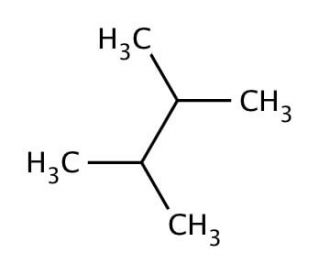

2,3-Dimethylbutane (CAS 79-29-8)
QUICK LINKS
2,3-Dimethylbutane holds a significant role as an alkane hydrocarbon featuring eight carbon atoms. This versatile compound finds paramount importance as a constituent of gasoline, serving both as a fuel and a solvent in various industrial applications. Moreover, its applications extend to the production of polymers, pharmaceuticals, and diverse chemicals. In the realm of scientific research, 2,3-DM has been the subject of numerous investigations exploring its physical and chemical properties, reactivity, and its utilization as a fuel and solvent. Additionally, studies have delved into its combustion characteristics and its potential role in ozone formation. The intriguing possibilities of employing it as a fuel additive and tapping into its potential as a renewable energy source have also been examined. Composed solely of carbon and hydrogen atoms, 2,3-Dimethylbutane stands as a non-polar molecule, devoid of a net electric charge. Consequently, it exhibits minimal attraction to other molecules, facilitating its easy movement through both air and water. However, its high flammability underlines its significance as a component of gasoline.
2,3-Dimethylbutane (CAS 79-29-8) References
- Experimental investigation of the low temperature oxidation of the five isomers of hexane. | Wang, Z., et al. 2014. J Phys Chem A. 118: 5573-94. PMID: 25007100
- Comparative Study of Cl-Atom Reactions in Solution Using Time-Resolved Vibrational Spectroscopy. | Shin, JY., et al. 2016. J Phys Chem B. 120: 3920-31. PMID: 27046419
- Emission characteristics of volatile organic compounds and their secondary organic aerosol formation potentials from a petroleum refinery in Pearl River Delta, China. | Zhang, Z., et al. 2017. Sci Total Environ. 584-585: 1162-1174. PMID: 28189307
- Emission factors of volatile organic compounds (VOCs) based on the detailed vehicle classification in a tunnel study. | Zhang, Q., et al. 2018. Sci Total Environ. 624: 878-886. PMID: 29275252
- Emission and health risk assessment of volatile organic compounds in various processes of a petroleum refinery in the Pearl River Delta, China. | Zhang, Z., et al. 2018. Environ Pollut. 238: 452-461. PMID: 29587216
- Topologically guided tuning of Zr-MOF pore structures for highly selective separation of C6 alkane isomers. | Wang, H., et al. 2018. Nat Commun. 9: 1745. PMID: 29717138
- Kinetics of the reactions of NO3 radical with alkanes. | Zhou, L., et al. 2019. Phys Chem Chem Phys. 21: 4246-4257. PMID: 30747177
- Aggregation behavior of partially contacted graphene sheets in six-carbon alkanes: all-atom molecular dynamics simulation. | Chen, S., et al. 2022. J Mol Model. 28: 169. PMID: 35614269
- Revelation of contributing mechanism of reactive oxygen species in photocatalytic ozonation heterocyclization of gaseous hexane isomers. | Chen, J., et al. 2023. Chemosphere. 316: 137759. PMID: 36621686
- Sequential Separation of Linear, Mono-, and Di-Branched Hexane Isomers on a Robust Coordination Polymer with Nonbonding Flexibility. | Chen, R., et al. 2023. Small. 19: e2207367. PMID: 36808807
Ordering Information
| Product Name | Catalog # | UNIT | Price | Qty | FAVORITES | |
2,3-Dimethylbutane, 100 ml | sc-238285 | 100 ml | $102.00 |