
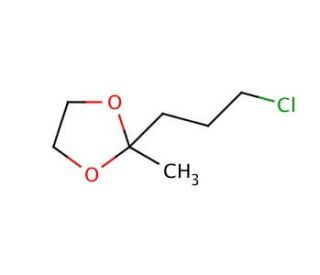

2-(3-Chloropropyl)-2-methyl-1,3-dioxolane (CAS 5978-08-5)
QUICK LINKS
2-(3-Chloropropyl)-2-methyl-1,3-dioxolane, known as CPMD, is a synthetic organic compound that has garnered significant attention in scientific research due to its distinct characteristics. 2-(3-Chloropropyl)-2-methyl-1,3-dioxolane is a cyclic ether featuring a chloropropyl group and a methyl group. It presents as a colorless liquid that exhibits high solubility in both water and organic solvents. The unique properties of 2-(3-Chloropropyl)-2-methyl-1,3-dioxolane have made it widely employed in scientific research. It serves as a solvent, reagent, and intermediate in the synthesis of diverse organic compounds. Furthermore, 2-(3-Chloropropyl)-2-methyl-1,3-dioxolane finds utility as a chiral auxiliary in asymmetric synthesis. Notably, it has been utilized as a probe in NMR spectroscopy to explore the structure and dynamics of proteins and nucleic acids. While the precise mechanism of action of 2-(3-Chloropropyl)-2-methyl-1,3-dioxolane remains elusive, it is believed that the compound can establish covalent bonds with amino acid residues in proteins, thereby inducing alterations in their conformation and activity. Additionally, 2-(3-Chloropropyl)-2-methyl-1,3-dioxolane has demonstrated an ability to influence the stability and functionality of nucleic acids.
2-(3-Chloropropyl)-2-methyl-1,3-dioxolane (CAS 5978-08-5) References
- C-alkylation of chiral tropane- and homotropane-derived enamines. | Hodgson, DM., et al. 2013. J Org Chem. 78: 1508-18. PMID: 23356473
- High yield conversion of doxorubicin to 2-pyrrolinodoxorubicin, an analog 500-1000 times more potent: structure-activity relationship of daunosamine-modified derivatives of doxorubicin. | Nagy, A., et al. 1996. Proc Natl Acad Sci U S A. 93: 2464-9. PMID: 8637897
Ordering Information
| Product Name | Catalog # | UNIT | Price | Qty | FAVORITES | |
2-(3-Chloropropyl)-2-methyl-1,3-dioxolane, 5 g | sc-223249 | 5 g | $50.00 |