
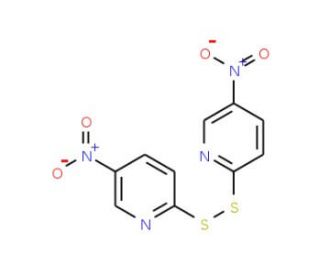

2,2′-Dithiobis(5-nitropyridine) (CAS 2127-10-8)
LINK RAPIDI
La 2,2'-Ditiobis(5-nitropiridina) è un composto chimico utilizzato principalmente nel campo della scienza dei materiali e della fotochimica per le sue proprietà uniche di accettazione degli elettroni e di fotochimica. La sua capacità di formare complessi di trasferimento di carica lo rende un candidato per lo studio dei meccanismi di trasferimento di elettroni. I gruppi nitro attaccati agli anelli di piridina aumentano la sua forza di sottrazione di elettroni, essenziale per la ricerca sullo sviluppo di nuovi materiali fotovoltaici. Inoltre, il ponte disolfuro della molecola può subire scissioni e riformazioni, una caratteristica che viene sfruttata nella ricerca sui materiali autorigeneranti e sulla reticolazione reversibile nelle reti polimeriche. Il suo ruolo nella formazione di polimeri conduttivi è altrettanto interessante, poiché questi materiali trovano applicazione nella creazione di nuovi tipi di dispositivi elettronici. Inoltre, la capacità del composto di assorbire la luce e di subire successive trasformazioni chimiche lo rende un cromoforo utile nello studio delle reazioni indotte dalla luce e nella progettazione dell'elettronica molecolare.
2,2′-Dithiobis(5-nitropyridine) (CAS 2127-10-8) Referenze
- Studi sulla deprotezione dei gruppi di protezione delle catene laterali di cisteina e selenocisteina. | Harris, KM., et al. 2007. J Pept Sci. 13: 81-93. PMID: 17031870
- Modulazione redox delle correnti K+ di tipo A nei neuroni del ganglio della radice dorsale sensibili al dolore. | Hsieh, CP. 2008. Biochem Biophys Res Commun. 370: 445-9. PMID: 18375201
- 2,2'-Ditiobis(5-nitropiridina) (DTNP) come deprotettore efficace e delicato per i comuni gruppi di protezione della cisteina. | Schroll, AL., et al. 2012. J Pept Sci. 18: 1-9. PMID: 22083608
- L'uso della 2,2'-ditiobis(5-nitropiridina) (DTNP) per la deprotezione e la formazione di diselenide in peptidi protetti contenenti selenocisteina. | Schroll, AL., et al. 2012. J Pept Sci. 18: 155-62. PMID: 22249911
- Rimozione del gruppo protettivo 5-nitro-2-piridina-solfenile dalla selenocisteina e dalla cisteina mediante ascorbolisi. | Ste Marie, EJ., et al. 2016. J Pept Sci. 22: 571-6. PMID: 27480992
- Sintesi ad alta resa del peptide 5 dell'insulina umana mediante una strategia non convenzionale. | Zaykov, AN., et al. 2018. Org Lett. 20: 3695-3699. PMID: 29874090
- Definizione di un metodo di HPLC che prevede la derivatizzazione precolonna con 2,2'-ditiobis (5-nitropiridina) per la determinazione dei solfiti nei gamberi in confronto alla cromatografia ionica. | Yang, K., et al. 2019. Food Sci Nutr. 7: 2151-2158. PMID: 31289663
- Facile rimozione del gruppo protettivo 4-metossibenzilico dalla selenocisteina. | Jenny, KA., et al. 2019. J Pept Sci. 25: e3209. PMID: 31410953
- Nuovo cluster Cu(I)-5-nitropiridina-2-tiolo con emissione NIR: Caratterizzazione strutturale e fotofisica. | Hassanein, K., et al. 2022. J Phys Chem C Nanomater Interfaces. 126: 10190-10198. PMID: 35774291
- Determinazione di composti solfidrilici semplici (a basso peso molecolare) e del loro contenuto in campioni biologici mediante l'uso di 2,2'-ditiobis-(5-nitropiridina). | Swatditat, A. and Tsen, CC. 1972. Anal Biochem. 45: 349-56. PMID: 5060597
- L'uso della 2,2'-ditiobis-(5-nitropiridina) come reagente selettivo per la rilevazione dei tioli. | Grassetti, DR. and Murray, JF. 1969. J Chromatogr. 41: 121-3. PMID: 5780855
- Effetti dei reagenti del gruppo SH sulle correnti dei canali Ca2+ e K+ delle cellule B pancreatiche. | Krippeit-Drews, P., et al. 1994. Biochem Biophys Res Commun. 200: 860-6. PMID: 8179620
- L'ossidazione solfidrilica induce la chiusura rapida e reversibile del canale K+ regolato dall'ATP nella beta-cellula pancreatica. | Islam, MS., et al. 1993. FEBS Lett. 319: 128-32. PMID: 8454044
- Ridotta sensibilità al diidrossiacetone e normale sensibilità alla gliceraldeide e agli agenti ossidanti dei canali K+ sensibili all'ATP delle cellule beta pancreatiche nei ratti NIDDM. | Song, DK., et al. 1997. J Korean Med Sci. 12: 286-92. PMID: 9288626
- Modulazione del canale K+ voltaggio-dipendente da parte del potenziale redox nelle cellule muscolari lisce arteriose polmonari e auricolari del coniglio. | Park, MK., et al. 1997. Pflugers Arch. 434: 764-71. PMID: 9306010
Informazioni ordini
| Nome del prodotto | Codice del prodotto | UNITÀ | Prezzo | Quantità | Preferiti | |
2,2′-Dithiobis(5-nitropyridine), 1 g | sc-251822 | 1 g | $84.00 |