
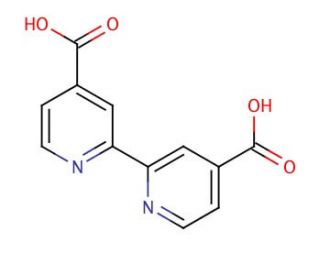

2,2′-Bipyridine-4,4′-dicarboxylic acid (CAS 6813-38-3)
QUICK LINKS
2,2′-Bipyridine-4,4′-dicarboxylic acid (2,2′-Bpydc) is an organic compound with intriguing potential across diverse scientific research fields. Belonging to the bipyridine family, it is characterized by two pyridine rings linked by a single bond. This white solid exhibits a melting point of 128°C and a boiling point of 267°C. Scientists have explored the wide-ranging applications of 2,2′-Bipyridine-4,4′-dicarboxylic acid in various scientific domains, including organic chemistry, materials science, and catalysis. In the realm of organic chemistry, researchers have harnessed 2,2′-Bipyridine-4,4′-dicarboxylic acid as a valuable starting material for synthesizing an array of compounds, such as heterocyclic compounds, polymers, and organometallic compounds. In materials science, this compound serves as a critical ligand for the creation of metal-organic frameworks and as a fundamental building block in the fabrication of nanomaterials. Furthermore, in catalysis, 2,2′-Bipyridine-4,4′-dicarboxylic acid has proven to be an efficient catalyst for the synthesis of organic compounds. While the precise mechanism of action of 2,2′-Bipyridine-4,4′-dicarboxylic acid remains partly mysterious, it is believed to act as both a Lewis acid, promoting the formation of covalent bonds between molecules, and a Brønsted acid, facilitating the catalysis of hydrogen bond formation. 2,2′-Bipyridine-4,4′-dicarboxylic acid shows tremendous promise as a versatile compound, inspiring numerous research avenues in the realms of organic chemistry, materials science, and catalysis, where its unique characteristics and properties contribute to groundbreaking advancements.
2,2′-Bipyridine-4,4′-dicarboxylic acid (CAS 6813-38-3) References
- Influence of 4-guanidinobutyric acid as coadsorbent in reducing recombination in dye-sensitized solar cells. | Zhang, Z., et al. 2005. J Phys Chem B. 109: 21818-24. PMID: 16853833
- Two elongated octahedral coordination cages constructed by M4-TC4A secondary building units (M = CoII and FeII) and 2,2'-bipyridine-4,4'-dicarboxylic acids. | Tan, H., et al. 2014. Inorg Chem. 53: 7083-5. PMID: 24988249
- Bis-conjugation of Bioactive Molecules to Cisplatin-like Complexes through (2,2'-Bipyridine)-4,4'-Dicarboxylic Acid with Optimal Cytotoxicity Profile Provided by the Combination Ethacrynic Acid/Flurbiprofen. | Biancalana, L., et al. 2020. Chemistry. 26: 17525-17535. PMID: 33252170
- Identification of folic acid and sulfaquinoxaline using a heterometallic Zn-Eu MOF as a sensor. | Li, D., et al. 2023. Dalton Trans. 52: 696-702. PMID: 36545891
Ordering Information
| Product Name | Catalog # | UNIT | Price | Qty | FAVORITES | |
2,2′-Bipyridine-4,4′-dicarboxylic acid, 1 g | sc-254303 | 1 g | $45.00 |