
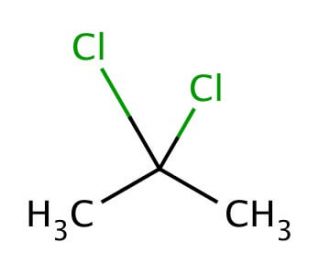

2,2-Dichloropropane (CAS 594-20-7)
QUICK LINKS
2,2-Dichloropropane, a versatile organic compound widely utilized in the chemical industry, serves numerous purposes. This colorless liquid possesses a potent odor and can dissolve in water. The chemical industry extensively employs 2,2-Dichloropropane for its versatility. As a solvent, it aids in the production of polymers, adhesives, and paints, showcasing its importance in various manufacturing processes. Moreover, scientific research heavily relies on 2,2-Dichloropropane, particularly in organic synthesis and biotechnology. It significantly contributes to the synthesis of organic compounds, including agrochemicals and polymers. Furthermore, it finds use as a solvent in the manufacturing of polymers, adhesives, and paints. Biotechnology benefits from 2,2-Dichloropropane′s involvement in the production of enzymes, proteins, and other essential biomolecules. Although the precise mechanism of action of 2,2-Dichloropropane remains elusive, it exhibits high reactivity. It is believed to undergo a free-radical reaction with chlorine, resulting in the formation of 2,2-dichloropropene. Subsequent oxidation processes lead to the generation of 2,2-dichloropropane. This chain of reactions contributes to the synthesis of diverse organic compounds.
2,2-Dichloropropane (CAS 594-20-7) References
- Metabolism and mutagenicity of source water contaminants 1,3-dichloropropane and 2,2-dichloropropane. | Tornero-Velez, R., et al. 2004. Drug Metab Dispos. 32: 123-31. PMID: 14709629
- Treatment of volatile organic chemicals on the EPA Contaminant Candidate List using ozonation and the O3/H2O2 advanced oxidation process. | Chen, WR., et al. 2006. Environ Sci Technol. 40: 2734-9. PMID: 16683616
- Sorption and inhibited dehydrohalogenation of 2,2-dichloropropane in micropores of dealuminated Y zeolites. | Cheng, H. and Reinhard, M. 2007. Environ Sci Technol. 41: 1934-41. PMID: 17410787
- A crystallographic and spectroscopic study on the reactions of WCl6 with carbonyl compounds. | Dolci, S., et al. 2013. Dalton Trans. 42: 5635-48. PMID: 23348911
- Groundwater Remediation of Volatile Organic Compounds Using Nanofiltration and Reverse Osmosis Membranes-A Field Study. | Ainscough, TJ., et al. 2021. Membranes (Basel). 11: PMID: 33467184
Ordering Information
| Product Name | Catalog # | UNIT | Price | Qty | FAVORITES | |
2,2-Dichloropropane, 5 g | sc-238224 | 5 g | $43.00 |