
Date published: 2025-12-4

1-800-457-3801

SCBT Portrait Logo
Seach Input

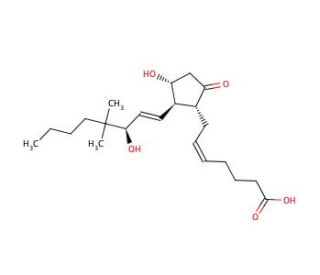
16,16-Dimethyl-prostaglandin E2 (CAS 39746-25-3)

5.0(1)
Write a reviewAsk a question

See product citations (2)

Alternate Names:
16,16-Dimethyl-prostaglandin E2 also known as 9-OXO-11ALPHA; 15R-DIHYDROXY-16,16-DIMETHYL-PROSTA-5Z,13E-DIEN-1-OIC ACID; (5z,11-alpha,13e,15r)-11, 15-dihydroxy-16,16-dimethyl-9-oxoprosta-5,13-dien-1; 15r)-13e;16,16-dimethyl-pge2; 5-heptenoicacid,7-(2-(4,4-dimethyl-3-hydroxy-1-octenyl)-3-hydroxy-5-oxocycl;opentyl)-;prosta-5,13-dien-1-oicacid,11,15-dihydroxy-16,16-dimethyl-9-oxo-,(5z,11-alph 16,16-dimethyl PGE2
Application:
16,16-Dimethyl-prostaglandin E2 is an antisecretory, antiulcer PGE2 analog that is resistant to metabolism
CAS Number:
39746-25-3
Purity:
≥98%
Molecular Weight:
380.52
Molecular Formula:
C22H36O5
Supplemental Information:
This is classified as a Dangerous Good for transport and may be subject to additional shipping charges.
For Research Use Only. Not Intended for Diagnostic or Therapeutic Use.
* Refer to Certificate of Analysis for lot specific data.

QUICK LINKS

16,16-Dimethyl-prostaglandin E2 is Prostaglandin E2 (PGE2 sc-201225) analog with potent cytoprotective activity that binds to PGDH (prostaglandin dehydrogenase or HPGD), but is resistant to metabolism, thereby inhibiting the enzyme. This enhanced resistance to metabolism imparts a higher duration of activity than Prostaglandin E2 (sc-201225), but the methylations do not severely affect the binding affinity for all four EP receptors (EP1, 2, 3, and 4). PGE2 is the most physiologically abundant eiconasoid regulating many biological functions and since this product has nearly identical binding affinities, 16,16-Dimethyl-prostaglandin E2 also has numerous and similar physiological functions. 16,16-Dimethyl-prostaglandin E2 is an inhibitor of PGDH and an activator of EP2.


16,16-Dimethyl-prostaglandin E,[object Object], (CAS 39746-25-3) References

  1. 16,16-Dimethyl prostaglandin E2 inhibits indomethacin-induced small intestinal lesions through EP3 and EP4 receptors.  |  Kunikata, T., et al. 2002. Dig Dis Sci. 47: 894-904. PMID: 11991626
  2. Subcutaneous or topical administration of 16,16 dimethyl prostaglandin E2 protects from radiation-induced alopecia in mice.  |  Hanson, WR., et al. 1992. Int J Radiat Oncol Biol Phys. 23: 333-7. PMID: 1587754
  3. Gastric antisecretory and antiulcer properties of PGE2, 15-methyl PGE2, and 16, 16-dimethyl PGE2. Intravenous, oral and intrajejunal administration.  |  Robert, A., et al. 1976. Gastroenterology. 70: 359-70. PMID: 174967
  4. 16,16-Dimethyl prostaglandin E2 efficacy on prevention and protection from bleomycin-induced lung injury and fibrosis.  |  Failla, M., et al. 2009. Am J Respir Cell Mol Biol. 41: 50-8. PMID: 19059888
  5. 16,16-Dimethyl prostaglandin E2 induces villus contraction in rats without affecting intestinal restitution.  |  Erickson, RA., et al. 1990. Gastroenterology. 99: 708-16. PMID: 2116342
  6. Studies on 15-hydroxyprostaglandin dehydrogenase with various prostaglandin analogues.  |  Ohno, H., et al. 1978. J Biochem. 84: 1485-94. PMID: 216666
  7. Treatment with 16,16'-dimethyl prostaglandin E2 before and after induction of colitis with trinitrobenzenesulfonic acid in rats decreases inflammation.  |  Allgayer, H., et al. 1989. Gastroenterology. 96: 1290-300. PMID: 2539306
  8. Early microcirculatory stasis in acute gastric mucosal injury in the rat and prevention by 16,16-dimethyl prostaglandin E2 or sodium thiosulfate.  |  Pihan, G., et al. 1986. Gastroenterology. 91: 1415-26. PMID: 2945748
  9. Gastric mucosal blood flow in rats after administration of 16,16-dimethyl prostaglandin E2 at a cytoprotective dose.  |  Leung, FW., et al. 1985. Gastroenterology. 88: 1948-53. PMID: 3873373
  10. Effect of 16,16-dimethyl prostaglandin E2 on the surface hydrophobicity of aspirin-treated canine gastric mucosa.  |  Lichtenberger, LM., et al. 1985. Gastroenterology. 88: 308-14. PMID: 3964778
  11. Effect of 16,16 dimethyl prostaglandin E2 on aspirin induced damage to rat gastric epithelial cells in tissue culture.  |  Terano, A., et al. 1984. Gut. 25: 19-25. PMID: 6197344
  12. Influence of long-term 16,16-dimethyl prostaglandin E2 treatment on the rat gastrointestinal mucosa.  |  Reinhart, WH., et al. 1983. Gastroenterology. 85: 1003-10. PMID: 6618097
  13. International Union of Pharmacology classification of prostanoid receptors: properties, distribution, and structure of the receptors and their subtypes.  |  Coleman, RA., et al. 1994. Pharmacol Rev. 46: 205-29. PMID: 7938166
  14. Identification of prostanoid receptors in rabbit non-pigmented ciliary epithelial cells.  |  Bhattacherjee, P., et al. 1996. Exp Eye Res. 62: 491-8. PMID: 8759517

Ordering Information

Product NameCatalog #UNITPriceQtyFAVORITES

16,16-Dimethyl-prostaglandin E2, 1 mg

sc-201240
1 mg
$145.00

16,16-Dimethyl-prostaglandin E2, 5 mg

sc-201240B
5 mg
$502.00

16,16-Dimethyl-prostaglandin E2, 10 mg

sc-201240A
10 mg
$949.00

What is the half-life of this compound in mice? Many texts site the extended half-life relative to PGE2 itself, but I am having trouble pinning down an exact value. Thank you.

Asked by: Jrysndrs
Thank you for your question. Literature states that this compound has a prolonged half-life in vivo due to its resistance to metabolism by 15-hydroxy PGDH. We could not find an exact half-life, however the following publication states that the mouse was dosed with the compound 2 days prior to tumor excision. Bennett, A., et al. "Treatment of mouse carcinoma in vivo with a prostaglandin E2 analogue and indomethacin." British journal of cancer 52.2 (1985): 245.
Answered by: Technical Support
Date published: 2017-09-11

Is there any dmPGE2 as GMP grade?

Asked by: OscarQB
Thank you for your question. Unfortunately we are not able to provide that information. Our compounds are not pharmaceutical grade and not manufactured under GMP guidelines, and should be used for research use only.
Answered by: Tech Service
Date published: 2017-04-27
  • y_2025, m_11, d_14, h_6CST
  • bvseo_bulk, prod_bvqa, vn_bulk_3.0.42
  • cp_1, bvpage1
  • co_hasquestionsanswers, tq_2
  • loc_en_US, sid_201240, prod, sort_[SortEntry(order=LAST_APPROVED_ANSWER_SUBMISSION_TIME, direction=DESCENDING)]
  • clientName_scbt
  • bvseo_sdk, java_sdk, bvseo-4.0.0
  • CLOUD, getContent, 121ms
  • QUESTIONS, PRODUCT
Rated 5 out of 5 by from SpethSpeth, JM. et al. (PubMed 24167196) found that ex vivo pulse treatment with 16,16-Dimethyl-prostaglandin E2, enhances the function of hematopoietic stem and progenitor cells. -SCBT Publication Review
Date published: 2015-07-09
  • y_2025, m_11, d_14, h_6
  • bvseo_bulk, prod_bvrr, vn_bulk_3.0.42
  • cp_1, bvpage1
  • co_hasreviews, tv_0, tr_1
  • loc_en_US, sid_201240, prod, sort_[SortEntry(order=SUBMISSION_TIME, direction=DESCENDING)]
  • clientName_scbt
  • bvseo_sdk, java_sdk, bvseo-4.0.0
  • CLOUD, getReviews, 15ms
  • REVIEWS, PRODUCT
16,16-Dimethyl-prostaglandin E 2 is rated 5.0 out of 5 by 1.
  • y_2025, m_11, d_14, h_6
  • bvseo_bulk, prod_bvrr, vn_bulk_3.0.42
  • cp_1, bvpage1
  • co_hasreviews, tv_0, tr_1
  • loc_en_US, sid_201240, prod, sort_[SortEntry(order=SUBMISSION_TIME, direction=DESCENDING)]
  • clientName_scbt
  • bvseo_sdk, java_sdk, bvseo-4.0.0
  • CLOUD, getAggregateRating, 187ms
  • REVIEWS, PRODUCT