
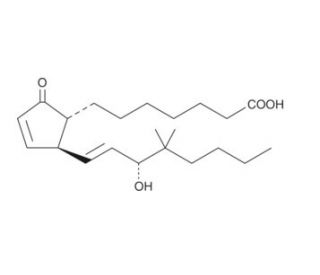

16,16-dimethyl Prostaglandin A1 (CAS 41692-24-4)
QUICK LINKS
16,16-dimethyl Prostaglandin A1 (16,16-dimethyl PGA1) is a synthetic analog of prostaglandin A1 (PGA1), a member of the prostaglandin family, which are lipid compounds with diverse hormone-like effects in animals. This particular derivative is modified with two methyl groups at the 16th carbon of the prostaglandin structure, enhancing its stability and modifying its interaction with biological systems compared to its parent compound, PGA1. In scientific research, 16,16-dimethyl PGA1 has been utilized to study the biochemistry and physiology of prostaglandins. This compound has been particularly valuable in exploring the mechanisms of action of prostaglandins in cellular signaling pathways. Prostaglandins, including PGA1 and its derivatives, are known to play a role in the regulation of inflammation, vascular tone, and immune responses by interacting with specific prostaglandin receptors on the surface of cells. The introduction of methyl groups in 16,16-dimethyl PGA1 affects the compound′s interaction with these receptors and other elements of the prostaglandin signaling pathways. Researchers have used this compound to understand how such modifications influence the biological activity of prostaglandins, including their role in modulating gene expression, affecting cytokine production, and altering enzymatic activities within the cell. Additionally, 16,16-dimethyl PGA1 has been used in studies investigating the role of prostaglandins in cellular protection mechanisms. For example, it has been examined in the context of stress responses where prostaglandins help in the maintenance of homeostasis and protection of cells under conditions of oxidative stress and other damaging stimuli.
16,16-dimethyl Prostaglandin A1 (CAS 41692-24-4) References
- Characterization of prostaglandin E2 binding to uterine membranes from baboon, rabbit and tree shrew (Tupaia belangeri). | Hodam, JR., et al. 1989. J Mol Endocrinol. 3: 33-42. PMID: 2742743
- Sustained injection of miR-499-5p alters the gastrocnemius muscle metabolome in broiler chickens. | Chen, C., et al. 2022. Arch Anim Breed. 65: 275-284. PMID: 36035876
- Integrated metabolomics and transcriptomics to reveal biomarkers and mitochondrial metabolic dysregulation of premature ovarian insufficiency. | Yu, Z., et al. 2023. Front Endocrinol (Lausanne). 14: 1280248. PMID: 38179298
- Untargeted metabolomics uncovers metabolic dysregulation and tissue sensitivity in ACE2 knockout mice. | Zhao, L., et al. 2024. Heliyon. 10: e27472. PMID: 38496880
- In vitro modulation of human and murine melanoma growth by prostanoid analogues. | Bregman, MD. and Meyskens, FL. 1983. Prostaglandins. 26: 449-56. PMID: 6581509
- Inhibition of growth in oral squamous carcinoma cells by cyclopentenone prostaglandins: comparison with chemotherapeutic agents. | ElAttar, TM. and Virji, AS. 1997. Prostaglandins Leukot Essent Fatty Acids. 56: 461-5. PMID: 9223658
Ordering Information
| Product Name | Catalog # | UNIT | Price | Qty | FAVORITES | |
16,16-dimethyl Prostaglandin A1, 1 mg | sc-205050 | 1 mg | $58.00 | |||
16,16-dimethyl Prostaglandin A1, 5 mg | sc-205050A | 5 mg | $600.00 |