
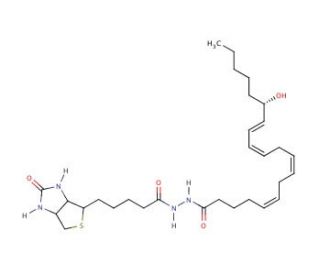

Molecular structure of 15(S)-HETE-biotin
15(S)-HETE-biotin
Application:
15(S)-HETE-biotin is an inhibitor of 5-LO (5-lipoxygenase)
Molecular Weight:
560.8
Molecular Formula:
C30H48N4O4S
Supplemental Information:
This is classified as a Dangerous Good for transport and may be subject to additional shipping charges.
For Research Use Only. Not Intended for Diagnostic or Therapeutic Use.
* Refer to Certificate of Analysis for lot specific data.
QUICK LINKS
Ordering Information
Description
Technical Information
Safety Information
SDS & Certificate of Analysis
15(S)-HETE-biotin is a major arachidonic acid metabolite produced by the 15-LO (15-lipoxygenase) pathway and is characterized as a potent inhibitor of 5-LO. The mechanism by which 15(S)-HETE acts as a leukotriene inhibitor is not clear. In studies with P-18 mast/basophil cells, it was shown that specific 15-HETE receptors, rather than esterification, appeared to be involved in signal transduction. 15(S)-HETE-biotin can be used to detect 15(S)-HETE binding proteins and/or receptors.
15(S)-HETE-biotin References
- 15(S)-hydroxyeicosatetraenoic acid (15-HETE), a product of arachidonic acid peroxidation, is an active component of hemozoin toxicity to monocytes. | Schwarzer, E., et al. 1999. Parassitologia. 41: 199-202. PMID: 10697856
- The eicosanoid, 15-(S)-HETE, stimulates secretion of mucin-like glycoprotein by the corneal epithelium. | Jackson, RS., et al. 2001. Cornea. 20: 516-21. PMID: 11413409
- 15-Hydroxyeicosatetraenoic acid (15-HETE) receptors. Involvement in the 15-HETE-induced stimulation of the cryptic 5-lipoxygenase in PT-18 mast/basophil cells. | Vonakis, BM. and Vanderhoek, JY. 1992. J Biol Chem. 267: 23625-31. PMID: 1331094
- 15-Lipoxygenases and its metabolites 15(S)-HETE and 13(S)-HODE in the development of non-small cell lung cancer. | Yuan, H., et al. 2010. Thorax. 65: 321-6. PMID: 20388757
- Effect of 15-lipoxygenase metabolites on angiogenesis: 15(S)-HPETE is angiostatic and 15(S)-HETE is angiogenic. | Soumya, SJ., et al. 2012. Inflamm Res. 61: 707-18. PMID: 22450700
- Enhancement of PLGF production by 15-(S)-HETE via PI3K-Akt, NF-κB and COX-2 pathways in rheumatoid arthritis synovial fibroblast. | Wu, MY., et al. 2013. Eur J Pharmacol. 714: 388-96. PMID: 23872401
- 15(S)-HETE-induced angiogenesis in adipose tissue is mediated through activation of PI3K/Akt/mTOR signaling pathway. | Soumya, SJ., et al. 2013. Biochem Cell Biol. 91: 498-505. PMID: 24219292
- Promotion of adipogenesis by 15-(S)-hydroxyeicosatetraenoic acid. | Song, YS., et al. 2016. Prostaglandins Other Lipid Mediat. 123: 1-8. PMID: 26905195
- (5Z,11Z,15R)-15-Hydroxyeicosa-5,11-dien-13-ynoic acid: A stable isomer of 15(S)-HETE that retains key vasoconstrictive and antiproliferative activity. | Pfister, SL., et al. 2016. Prostaglandins Other Lipid Mediat. 123: 33-9. PMID: 27117058
- 15-Lipoxygenase-2/15(S)-hydroxyeicosatetraenoic acid regulates cell proliferation and metastasis via the STAT3 pathway in lung adenocarcinoma. | Yang, L., et al. 2018. Prostaglandins Other Lipid Mediat. 138: 31-40. PMID: 30110652
- Utility of 15(S)-HETE as a Serological Marker for Eosinophilic Esophagitis. | Lu, S., et al. 2018. Sci Rep. 8: 14498. PMID: 30266946
- Inhibition of leukotriene biosynthesis by the leukocyte product 15-hydroxy-5,8,11,13-eicosatetraenoic acid. | Vanderhoek, JY., et al. 1980. J Biol Chem. 255: 10064-6. PMID: 6253463
- Characterization of specific subcellular 15-hydroxyeicosatetraenoic acid (15-HETE) binding sites on rat basophilic leukemia cells. | Kang, LT. and Vanderhoek, JY. 1995. Biochim Biophys Acta. 1256: 297-304. PMID: 7786891
- Synthesis and use of a novel biotinylated probe for the chemiluminescent detection of proteins that bind 15-hydroxyeicosatetraenoic acid. | Kang, LT. and Vanderhoek, JY. 1997. Anal Biochem. 250: 119-22. PMID: 9234906
Inhibitor of:
5-LO.Ordering Information
| Product Name | Catalog # | UNIT | Price | Qty | FAVORITES | |
15(S)-HETE-biotin, 25 µg | sc-220636 | 25 µg | $237.00 | |||
15(S)-HETE-biotin, 50 µg | sc-220636A | 50 µg | $341.00 |