
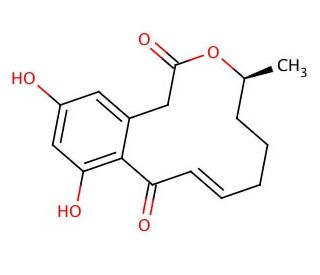

10,11-Dehydrocurvularin (CAS 1095588-70-7)
QUICK LINKS
10,11-Dehydrocurvularin, cataloged under CAS number 1095588-70-7, is a structural analog of curvularin, a macrocyclic lactone with notable biological properties. This compound features a distinctive modification: the removal of a hydrogen atom to introduce a double bond between the 10th and 11th carbon atoms in the lactone ring, enhancing its biochemical activity. 10,11-Dehydrocurvularin acts primarily by interfering with the cell cycle of fungi and possibly other cells by inhibiting proper spindle formation during mitosis. This disruption prevents the chromosomes from aligning and segregating correctly during cell division, leading to cell cycle arrest and potentially cell death. In research contexts, 10,11-Dehydrocurvularin is particularly valuable for studying the mechanisms of cell division and mitotic regulation. It provides insights into how alterations in the molecular structure of such compounds affect their interaction with biological targets involved in critical cellular processes. Researchers employ this compound to probe the dynamics of spindle assembly and to understand the pathways that regulate cell cycle progression in various organisms. These investigations help delineate the fundamental aspects of cell biology and contribute to the broader field of molecular biology by elucidating how natural substances can influence complex cellular functions.
10,11-Dehydrocurvularin (CAS 1095588-70-7) References
- Characterization of the biosynthetic genes for 10,11-dehydrocurvularin, a heat shock response-modulating anticancer fungal polyketide from Aspergillus terreus. | Xu, Y., et al. 2013. Appl Environ Microbiol. 79: 2038-47. PMID: 23335766
- Comparison of 10,11-Dehydrocurvularin Polyketide Synthases from Alternaria cinerariae and Aspergillus terreus Highlights Key Structural Motifs. | Cochrane, RV., et al. 2015. Chembiochem. 16: 2479-83. PMID: 26493380
- Condensation of Macrocyclic Polyketides Produced by Penicillium sp. DRF2 with Mercaptopyruvate Represents a New Fungal Detoxification Pathway. | de Castro, MV., et al. 2016. J Nat Prod. 79: 1668-78. PMID: 27227682
- Dehydrocurvularin is a potent antineoplastic agent irreversibly blocking ATP-citrate lyase: evidence from chemoproteomics. | Deng, Z., et al. 2019. Chem Commun (Camb). 55: 4194-4197. PMID: 30895984
- 10,11-dehydrocurvularin exerts antitumor effect against human breast cancer by suppressing STAT3 activation. | Zhao, Q., et al. 2021. Acta Pharmacol Sin. 42: 791-800. PMID: 32868906
- Inhibition of human glioblastoma multiforme cells by 10,11-dehydrocurvularin through the MMP-2 and PI3K/AKT signaling pathways. | Yan, H., et al. 2022. Eur J Pharmacol. 936: 175348. PMID: 36306925
- 10,11-Dehydrocurvularin attenuates inflammation by suppressing NLRP3 inflammasome activation. | Zhao, Q., et al. 2023. Chin J Nat Med. 21: 163-171. PMID: 37003639
Ordering Information
| Product Name | Catalog # | UNIT | Price | Qty | FAVORITES | |
10,11-Dehydrocurvularin, 1 mg | sc-391513 | 1 mg | $218.00 |