
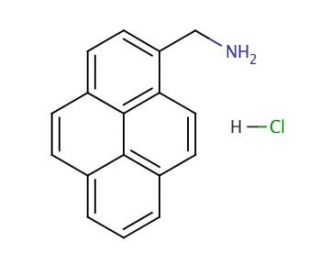

1-Pyrenemethylamine hydrochloride (CAS 93324-65-3)
QUICK LINKS
1-Pyrenemethylamine hydrochloride functions as a fluorescent probe. It is used to label and visualize specific molecules or structures within cells or tissues. 1-Pyrenemethylamine hydrochloride′s mechanism of action involves binding to target molecules or structures, leading to the emission of fluorescent light when excited by a specific wavelength of light. This allows tracking and studying the localization and movement of the labeled molecules or structures in various experimental systems.1-Pyrenemethylamine hydrochloride can be utilized to monitor changes in molecular interactions or conformational changes within biological systems. Its ability to emit fluorescent light upon binding to specific targets may be a useful for studying various biological processes at the molecular level.
1-Pyrenemethylamine hydrochloride (CAS 93324-65-3) References
- ZnS nanocrystals decorated single-walled carbon nanotube based chemiresistive label-free DNA sensor. | Rajesh, ., et al. 2011. Appl Phys Lett. 98: 13701. PMID: 21286239
- Synthesis of (-)-julocrotine and a diversity oriented Ugi-approach to analogues and probes. | Neves Filho, RA., et al. 2011. Beilstein J Org Chem. 7: 1504-7. PMID: 22238524
- Interaction of cyclodextrins with pyrene-modified polyacrylamide in a mixed solvent of water and dimethyl sulfoxide as studied by steady-state fluorescence. | Hashidzume, A., et al. 2012. Beilstein J Org Chem. 8: 1312-7. PMID: 23019465
- Microstructural and electrochemical impedance characterization of bio-functionalized ultrafine ZnS nanocrystals-reduced graphene oxide hybrid for immunosensor applications. | Mishra, SK., et al. 2013. Nanoscale. 5: 10494-503. PMID: 24056976
- Charge-transfer interaction mediated organogels from 18β-glycyrrhetinic acid appended pyrene. | Hu, J., et al. 2013. Beilstein J Org Chem. 9: 2877-85. PMID: 24367453
- Amplified polarization properties of electrospun nanofibers containing fluorescent dyes and helical polymer. | Kaerkitcha, N. and Sagawa, T. 2018. Photochem Photobiol Sci. 17: 342-351. PMID: 29445786
- Effect of the Polyketone Aromatic Pendent Groups on the Electrical Conductivity of the Derived MWCNTs-Based Nanocomposites. | Migliore, N., et al. 2018. Polymers (Basel). 10: PMID: 30966653
- Emergent Behaviors in Kinetically Controlled Dynamic Self-Assembly of Synthetic Molecular Systems. | Avinash, MB., et al. 2016. ACS Omega. 1: 378-387. PMID: 31457135
- A colorimetric chemosensor for pyrophosphate based on mono-pyrenylurea in aqueous media. | Cui, F., et al. 2020. Spectrochim Acta A Mol Biomol Spectrosc. 241: 118658. PMID: 32650244
- Mucus-penetrating PEGylated polysuccinimide-based nanocarrier for intravaginal delivery of siRNA battling sexually transmitted infections. | Currie, S., et al. 2020. Colloids Surf B Biointerfaces. 196: 111287. PMID: 32768985
- A quick one-step synthesis of luminescent gold nanospheres. | Candreva, A., et al. 2020. Soft Matter. 16: 10865-10868. PMID: 33305775
- DNA origami deposition on native and passivated molybdenum disulfide substrates. | Zhang, X., et al. 2014. Beilstein J Nanotechnol. 5: 501-506. PMID: 33708460
- Core-Shell Pluronic-Organosilica Nanoparticles with Controlled Polarity and Oxygen Permeability. | De La Encarnacion Bermudez, C., et al. 2021. Langmuir. 37: 4802-4809. PMID: 33851534
- A three-tiered colloidosomal microreactor for continuous flow catalysis. | Wu, H., et al. 2021. Nat Commun. 12: 6113. PMID: 34671044
- Robust drug bioavailability and safety for rheumatoid arthritis therapy using D-amino acids-based supramolecular hydrogels. | Ma, S., et al. 2022. Mater Today Bio. 15: 100296. PMID: 35665233
Ordering Information
| Product Name | Catalog # | UNIT | Price | Qty | FAVORITES | |
1-Pyrenemethylamine hydrochloride, 1 g | sc-224821 | 1 g | $93.00 |