
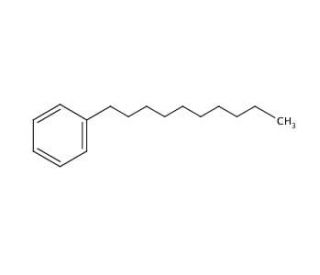

1-Phenyldecane (CAS 104-72-3)
QUICK LINKS
1-Phenyldecane is an organic compound that is often a subject of study within the disciplines of organic chemistry and materials science. Its long alkyl chain coupled with a terminal phenyl group makes it a valuable compound for examining the properties of hydrophobic interactions in the context of molecular assemblies and supramolecular structures. Researchers use 1-Phenyldecane to explore the liquid crystalline behavior of similar molecules, as the phenyl group can contribute to mesogenic properties that are important in the design of liquid crystal displays. In addition, 1-Phenyldecane is investigated for its role as a non-polar solvent or as a component in mixtures that model the behavior of more complex hydrophobic systems. The compound also serves as a reference hydrocarbon in studies aimed at understanding the thermodynamics and kinetics of reactions involving hydrophobic substrates. Beyond its use as a model compound, 1-Phenyldecane is also used in the synthesis of larger organic molecules, where its carbon chain can be functionalized to create new compounds with desired physical and chemical properties.
1-Phenyldecane (CAS 104-72-3) References
- Solvent controlled self-assembly at the liquid-solid interface revealed by STM. | Mamdouh, W., et al. 2006. J Am Chem Soc. 128: 317-25. PMID: 16390161
- Characterization of four potential laser-induced fluorescence tracers for diesel engine applications. | Trost, J., et al. 2013. Appl Opt. 52: 8001-7. PMID: 24513750
- Metabolomics and metabolic pathway networks from human colorectal cancers, adjacent mucosa, and stool. | Brown, DG., et al. 2016. Cancer Metab. 4: 11. PMID: 27275383
- Heat-stabilised rice bran consumption by colorectal cancer survivors modulates stool metabolite profiles and metabolic networks: a randomised controlled trial. | Brown, DG., et al. 2017. Br J Nutr. 117: 1244-1256. PMID: 28643618
- Navy Bean and Rice Bran Intake Alters the Plasma Metabolome of Children at Risk for Cardiovascular Disease. | Li, KJ., et al. 2017. Front Nutr. 4: 71. PMID: 29404331
- Cometabolic mineralization of benzo[a]pyrene caused by hydrocarbon additions to soil. | Kanaly, RA. and Bartha, R. 1999. Environ Toxicol Chem. 18: 2186-2190. PMID: 29857609
- Navy Beans Impact the Stool Metabolome and Metabolic Pathways for Colon Health in Cancer Survivors. | Baxter, BA., et al. 2018. Nutrients. 11: PMID: 30583518
- Production and characterisation of a marine Halomonas surface-active exopolymer. | Gutierrez, T., et al. 2020. Appl Microbiol Biotechnol. 104: 1063-1076. PMID: 31813048
- Current Status of and Future Perspectives in Bacterial Degradation of Benzo[a]pyrene. | Nzila, A. and Musa, MM. 2020. Int J Environ Res Public Health. 18: PMID: 33396411
- VEGFR-2 kinase domain inhibition as a scaffold for anti-angiogenesis: Validation of the anti-angiogenic effects of carotenoids from Spondias mombin in DMBA model of breast carcinoma in Wistar rats. | Metibemu, DS., et al. 2021. Toxicol Rep. 8: 489-498. PMID: 34408968
- Polyethylene Terephthalate (PET) Bottle-to-Bottle Recycling for the Beverage Industry: A Review. | Benyathiar, P., et al. 2022. Polymers (Basel). 14: PMID: 35745942
- Structure-biodegradability relationships of polycyclic aromatic hydrocarbons in soil. | Bossert, ID. and Bartha, R. 1986. Bull Environ Contam Toxicol. 37: 490-5. PMID: 3768542
Ordering Information
| Product Name | Catalog # | UNIT | Price | Qty | FAVORITES | |
1-Phenyldecane, 25 g | sc-229806 | 25 g | $158.00 |