
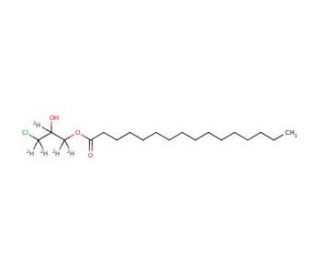

1-Palmitoyl-3-chloropropanediol-d5 (CAS 1346599-60-7)
QUICK LINKS
1-Palmitoyl-3-chloropropanediol-d5, referred to as PC-Cl-d5, is a deuterated variant of 1-palmitoyl-3-chloropropanediol (PC-Cl), a synthetic lipid with substantial significance in cellular membrane research, particularly concerning sphingolipid metabolism. The development of deuterated 1-Palmitoyl-3-chloropropanediol-d5 allows for its detection and quantification in biological samples using mass spectrometry techniques. Numerous studies have employed 1-Palmitoyl-3-chloropropanediol-d5 to explore its impact on cellular membranes and sphingolipid metabolism. One notable finding is that 1-Palmitoyl-3-chloropropanediol-d5 induces the formation of ceramide-enriched membrane domains, which can influence the activity of membrane proteins and signaling pathways. Investigations involving 1-Palmitoyl-3-chloropropanediol-d5 have also focused on the metabolism and turnover of sphingomyelin, a vital component of cell membranes. The incorporation of 1-Palmitoyl-3-chloropropanediol-d5 into cellular membranes affects their structure and function, leading to the formation of ceramide-enriched membrane domains that impact membrane protein activity and signaling pathways. It is worth noting that 1-Palmitoyl-3-chloropropanediol-d5 can undergo metabolization to generate PC-Cl, further influencing sphingolipid metabolism. The mechanism of action of 1-Palmitoyl-3-chloropropanediol-d5 involves its integration into cellular membranes, exerting effects on membrane organization and functionality. The induction of ceramide-enriched membrane domains by r1-Palmitoyl-3-chloropropanediol-d5 adds complexity to the modulation of membrane protein activity and signaling pathways.
1-Palmitoyl-3-chloropropanediol-d5 (CAS 1346599-60-7) References
- Occurrence of 3-MCPD and glycidyl esters in edible oils in the United States. | MacMahon, S., et al. 2013. Food Addit Contam Part A Chem Anal Control Expo Risk Assess. 30: 2081-92. PMID: 24138540
- Occurrence of 3-monochloropropane-1,2-diol (3-MCPD) esters and glycidyl esters in infant formulas from Germany. | Beekman, JK., et al. 2021. Food Addit Contam Part A Chem Anal Control Expo Risk Assess. 38: 1656-1671. PMID: 34237243
- Ultrasound-assisted enzymatic indirect determination of total 3-monochloropropane-1,2-diol esters in canned fish oil fraction. | Custodio-Mendoza, JA., et al. 2023. Food Chem. 403: 134423. PMID: 36183472
- Development of a QuEChERS method for simultaneous analysis of 3-Monochloropropane-1,2-diol monoesters and Glycidyl esters in edible oils and margarine by LC-APCI-MS/MS. | Custodio-Mendoza, JA., et al. 2023. Anal Chim Acta. 1239: 340712. PMID: 36628717
Ordering Information
| Product Name | Catalog # | UNIT | Price | Qty | FAVORITES | |
1-Palmitoyl-3-chloropropanediol-d5, 1 mg | sc-213402 | 1 mg | $349.00 |