
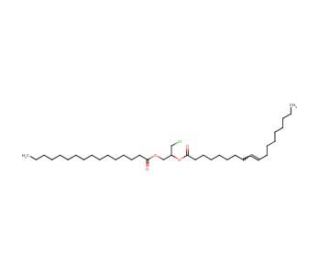

1-Palmitoyl-2-oleoyl-3-chloropropanediol (CAS 1363153-60-9)
QUICK LINKS
1-Palmitoyl-2-oleoyl-3-chloropropanediol is a compound that functions as a surfactant in experimental applications. It acts by reducing the surface tension between two substances, allowing them to mix more easily. At the molecular level, 1-Palmitoyl-2-oleoyl-3-chloropropanediol interacts with the interface between two immiscible phases, such as oil and water, to facilitate the formation of stable emulsions. This surfactant molecule contains a hydrophilic head group and a hydrophobic tail, which enables it to orient itself at the interface between different phases, stabilizing the emulsion. By lowering the interfacial tension, 1-Palmitoyl-2-oleoyl-3-chloropropanediol promotes the dispersion of one phase into another, which may be useful for creating stable emulsions in experimental systems. Its mechanism of action involves the adsorption of the surfactant molecules at the interface, leading to a reduction in the free energy of the system and the formation of a stable emulsion.
1-Palmitoyl-2-oleoyl-3-chloropropanediol (CAS 1363153-60-9) References
- Novel approaches to analysis of 3-chloropropane-1,2-diol esters in vegetable oils. | Moravcova, E., et al. 2012. Anal Bioanal Chem. 402: 2871-83. PMID: 22287050
- Comparison of indirect and direct quantification of esters of monochloropropanediol in vegetable oil. | Dubois, M., et al. 2012. J Chromatogr A. 1236: 189-201. PMID: 22444428
- Acute oral toxicity of 3-MCPD mono- and di-palmitic esters in Swiss mice and their cytotoxicity in NRK-52E rat kidney cells. | Liu, M., et al. 2012. Food Chem Toxicol. 50: 3785-91. PMID: 22847132
- Insights into the formation mechanism of chloropropanol fatty acid esters under laboratory-scale deodorization conditions. | Hori, K., et al. 2016. J Biosci Bioeng. 122: 246-51. PMID: 26822095
- Development of a partitioned liquid-liquid extraction- dispersive solid phase extraction procedure followed by liquid chromatography-tandem mass spectrometry for analysis of 3-monochloropropane-1,2-diol diesters in edible oils. | Custodio-Mendoza, JA., et al. 2018. J Chromatogr A. 1548: 19-26. PMID: 29555360
- In vitro toxicological assessment of free 3-MCPD and select 3-MCPD esters on human proximal tubule HK-2 cells. | Mossoba, ME., et al. 2020. Cell Biol Toxicol. 36: 209-221. PMID: 31686351
- Mitigating the formation of monochloropropanediol diesters in vegetable oils by removing their residual sediments. | Theurillat, X., et al. 2020. Food Chem. 313: 125926. PMID: 31945703
- A method to dissolve 3-MCPD mono- and di-esters in aqueous cell culture media. | Mapa, MST., et al. 2020. MethodsX. 7: 100774. PMID: 32140439
- Evaluation of transporter expression in HK-2 cells after exposure to free and ester-bound 3-MCPD. | Mossoba, ME., et al. 2021. Toxicol Rep. 8: 436-442. PMID: 33717996
- Recommendations for Oil Extraction and Refining Process to Prevent the Formation of Monochloropropane-diol Esters in Sunflower Oil. | Redeuil, K., et al. 2021. J Agric Food Chem. 69: 6043-6053. PMID: 34018724
Ordering Information
| Product Name | Catalog # | UNIT | Price | Qty | FAVORITES | |
1-Palmitoyl-2-oleoyl-3-chloropropanediol, 10 mg | sc-213399 | 10 mg | $337.00 |