
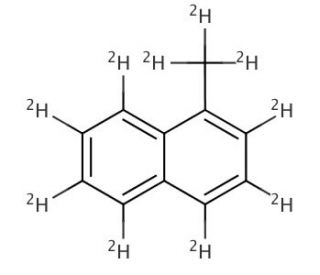

1-Methylnaphthalene-d10 (CAS 38072-94-5)
QUICK LINKS
1-Methylnaphthalene-d10, with its deuterium-enriched structure, serves as a tool in the field of materials science and organic chemistry research. It is often utilized in tracing the environmental fate of naphthalene-based compounds, which are common in various industrial applications and can be persistent environmental pollutants. The deuterium atoms provide a significant advantage in spectroscopic studies, enabling the compound to be used as an internal standard, which is for the accurate quantification of similar organic molecules in complex mixtures. In addition, this compound is used in mechanistic studies to understand the reactivity of aromatic compounds, as the presence of deuterium can subtly alter reaction kinetics and pathways. Its application is also found in the study of organic photovoltaic materials, where 1-methylnaphthalene analogs may play a role in the design of new compounds with improved electronic properties.
1-Methylnaphthalene-d10 (CAS 38072-94-5) References
- PAH metabolites in bile, cytochrome P4501A and DNA adducts as environmental risk parameters for chronic oil exposure: a laboratory experiment with Atlantic cod. | Aas, E., et al. 2000. Aquat Toxicol. 51: 241-58. PMID: 11064127
- Some factors affecting SPME analysis and PAHs in Philadelphia's urban waterways. | Cheng, X., et al. 2013. Water Res. 47: 2331-40. PMID: 23453588
- Occurrence and leachability of polycyclic aromatic compounds in contaminated soils: Chemical and bioanalytical characterization. | Larsson, M., et al. 2018. Sci Total Environ. 622-623: 1476-1484. PMID: 29890612
- Soil-sebum partition coefficients for high molecular weight polycyclic aromatic hydrocarbons (HMW-PAH). | Beriro, DJ., et al. 2020. J Hazard Mater. 398: 122633. PMID: 32512434
- Exploring the external exposome using wearable passive samplers - The China BAPE study. | Koelmel, JP., et al. 2021. Environ Pollut. 270: 116228. PMID: 33360595
- Spatial and temporal distributions of polycyclic aromatic hydrocarbons in sediments from the Canadian Arctic Archipelago. | Corminboeuf, A., et al. 2021. Mar Pollut Bull. 171: 112729. PMID: 34298327
- Polycyclic aromatic hydrocarbons at subcritical levels as novel indicators of microbial adaptation in a pre-industrial river delta. | Wang, Y., et al. 2022. Chemosphere. 295: 133858. PMID: 35124082
- Determination of 123 polycyclic aromatic hydrocarbons and their derivatives in atmospheric samples. | Zhang, ZF., et al. 2022. Chemosphere. 296: 134025. PMID: 35218781
Ordering Information
| Product Name | Catalog # | UNIT | Price | Qty | FAVORITES | |
1-Methylnaphthalene-d10, 500 mg | sc-224757 | 500 mg | $194.00 |