
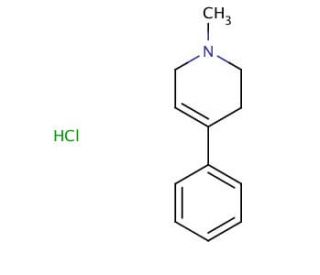

1-Methyl-4-phenyl-1,2,3,6-tetrahydropyridine, Hydrochloride (CAS 23007-85-4)
See product citations (12)
Available in US only.
QUICK LINKS
1-Methyl-4-phenyl-1,2,3,6-tetrahydropyridine, Hydrochloride (MPTP-HCl) is a dopaminergic neurotoxin that causes permanent symptoms of Parkinson′s disease by killing certain neurons in the substantia nigra of the brain. For this reason, it can be useful in the study of Parkinson′s disease. Specifically, it acts by targeting the mitochondria of neurons, where it is converted to 1-methyl-4-phenylpyridinium (MPP+). MPP+ is the active neurotoxin and inhibits mitochondrial complex I, leading to oxidative stress and neuronal death. In addition, 1-Methyl-4-phenyl-1,2,3,6-tetrahydropyridine, Hydrochloride affects dopamine metabolism and induces the release of glutamate. 1-Methyl-4-phenyl-1,2,3,6-tetrahydropyridine, Hydrochloride is also known as MPTP hydrochloride and Dopaminergic neurotoxin.
1-Methyl-4-phenyl-1,2,3,6-tetrahydropyridine, Hydrochloride (CAS 23007-85-4) References
- Therapeutic effects of arotinolol, a beta-adrenergic blocker, on tremor in MPTP-induced parkinsonian monkeys. | Kuno, S., et al. 1992. Clin Neuropharmacol. 15: 381-6. PMID: 1384970
- 3,4-methylenedioxymethamphetamine (ecstasy) inhibits dyskinesia expression and normalizes motor activity in 1-methyl-4-phenyl-1,2,3,6-tetrahydropyridine-treated primates. | Iravani, MM., et al. 2003. J Neurosci. 23: 9107-15. PMID: 14534244
- Biochemical, behavioral and immunohistochemical alterations in MPTP-treated mouse model of Parkinson's disease. | Kurosaki, R., et al. 2004. Pharmacol Biochem Behav. 78: 143-53. PMID: 15159144
- MPTP treatment in mice does not transmit and cause Parkinsonian neurotoxicity in non-treated cagemates through close contact. | Lau, YS., et al. 2005. Neurosci Res. 52: 371-8. PMID: 15936837
- Biochemical alterations of the striatum in an MPTP-treated mouse model of Parkinson's disease. | Kuroiwa, H., et al. 2010. Metab Brain Dis. 25: 177-83. PMID: 20431930
- Neuropharmacological approach against MPTP (1-methyl-4-phenyl-1,2,3,6- tetrahydropyridine)-induced mouse model of Parkinson's disease. | Yokoyama, H., et al. 2011. Acta Neurobiol Exp (Wars). 71: 269-80. PMID: 21731080
- Probenecid potentiates MPTP/MPP+ toxicity by interference with cellular energy metabolism. | Alvarez-Fischer, D., et al. 2013. J Neurochem. 127: 782-92. PMID: 23802648
- Neurotrophic Effect of Asiatic acid, a Triterpene of Centella asiatica Against Chronic 1-Methyl 4-Phenyl 1, 2, 3, 6-Tetrahydropyridine Hydrochloride/Probenecid Mouse Model of Parkinson's disease: The Role of MAPK, PI3K-Akt-GSK3β and mTOR Signalling Pathways. | Nataraj, J., et al. 2017. Neurochem Res. 42: 1354-1365. PMID: 28181071
- Connexin 30 deficiency attenuates A2 astrocyte responses and induces severe neurodegeneration in a 1-methyl-4-phenyl-1,2,3,6-tetrahydropyridine hydrochloride Parkinson's disease animal model. | Fujita, A., et al. 2018. J Neuroinflammation. 15: 227. PMID: 30103794
- β-Caryophyllene exerts protective antioxidant effects through the activation of NQO1 in the MPTP model of Parkinson's disease. | Flores-Soto, ME., et al. 2021. Neurosci Lett. 742: 135534. PMID: 33271195
- The use of the MPTP-treated mouse as an animal model of parkinsonism. | Heikkila, RE. and Sonsalla, PK. 1987. Can J Neurol Sci. 14: 436-40. PMID: 3499967
- Plasticity of the nigrostriatal system in MPTP-treated mice. A biochemical and morphological correlation. | Cruz-Sanchez, FF., et al. 1993. Mol Chem Neuropathol. 19: 163-76. PMID: 8103334
- Acute MPTP treatment produces no changes in mitochondrial complex activities and indices of oxidative damage in the common marmoset ex vivo one week after exposure to the toxin. | Gerlach, M., et al. 1996. Neurochem Int. 28: 41-9. PMID: 8746763
Ordering Information
| Product Name | Catalog # | UNIT | Price | Qty | FAVORITES | |
1-Methyl-4-phenyl-1,2,3,6-tetrahydropyridine, Hydrochloride, 25 mg | sc-206178 | 25 mg | $156.00 | |||
| US: Only available in the US | ||||||
1-Methyl-4-phenyl-1,2,3,6-tetrahydropyridine, Hydrochloride, 250 mg | sc-206178A | 250 mg | $826.00 | |||
| US: Only available in the US | ||||||
1-Methyl-4-phenyl-1,2,3,6-tetrahydropyridine, Hydrochloride, 500 mg | sc-206178B | 500 mg | $1301.00 | |||
| US: Only available in the US | ||||||
1-Methyl-4-phenyl-1,2,3,6-tetrahydropyridine, Hydrochloride, 1 g | sc-206178C | 1 g | $2091.00 | |||
| US: Only available in the US | ||||||