
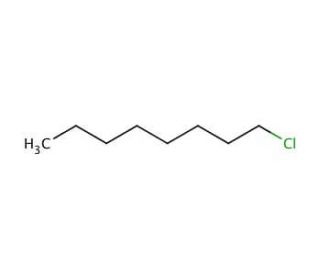

1-Chlorooctane (CAS 111-85-3)
QUICK LINKS
1-Chlorooctane, possessing the chemical formula C8H17Cl, emerges as an organic compound. Displaying the characteristics of a colorless liquid, it carries a distinctly sweet and pungent scent. Its utility spans various industrial and scientific domains, primarily manifesting as a solvent for organic synthesis, a reagent driving the creation of diverse compounds, and a foundational component for the synthesis of other substances. In scientific research, 1-Chlorooctane assumes a multifaceted role. Its application encompasses serving as a reagent in the intricate process of organic synthesis, especially where the introduction of halogen atoms is concerned. This versatile compound equally finds use as a solvent, contributing to the meticulous preparation of organic entities. Beyond these roles, 1-Chlorooctane significantly contributes to the production of plasticizers and even finds a niche as a fuel additive. Within the scope of organic reactions, 1-Chlorooctane takes on the role of a nucleophile. Its reactivity hinges on both the nature of the substrate and the prevailing reaction conditions. Notably, it interacts harmoniously with a spectrum of electrophiles, encompassing alkenes and alkynes, ultimately yielding substitution products. Furthermore, its potential extends to reactions with carboxylic acids, yielding esters, and reactions with alcohols, culminating in the formation of ethers.
1-Chlorooctane (CAS 111-85-3) References
- Aqueous solubility, Henry's law constants and air/water partition coefficients of n-octane and two halogenated octanes. | Sarraute, S., et al. 2004. Chemosphere. 57: 1543-51. PMID: 15519399
- Phase behavior and microstructure of C12E5 nonionic microemulsions with chlorinated oils. | Deen, GR. and Pedersen, JS. 2008. Langmuir. 24: 3111-7. PMID: 18307365
- Identification of urinary sex pheromones in female buffaloes and their influence on bull reproductive behaviour. | Rajanarayanan, S. and Archunan, G. 2011. Res Vet Sci. 91: 301-5. PMID: 21316068
- Sodium Diisopropylamide-Mediated Dehydrohalogenations: Influence of Primary- and Secondary-Shell Solvation. | Ma, Y., et al. 2019. J Org Chem. 84: 10860-10869. PMID: 31436099
- Nickel-catalyzed C-H alkylation of indoles with unactivated alkyl chlorides: evidence of a Ni(i)/Ni(iii) pathway. | Pandey, DK., et al. 2019. Chem Sci. 10: 9493-9500. PMID: 32110305
- Nickel-Catalyzed Cross-Electrophile Coupling of Aryl Chlorides with Primary Alkyl Chlorides. | Kim, S., et al. 2020. J Am Chem Soc. 142: 9902-9907. PMID: 32412241
- Alkali-Metal Mediation: Diversity of Applications in Main-Group Organometallic Chemistry. | Gentner, TX. and Mulvey, RE. 2021. Angew Chem Int Ed Engl. 60: 9247-9262. PMID: 33017511
- Simply Applicable Method for Microplastics Determination in Environmental Samples. | Šunta, U., et al. 2021. Molecules. 26: PMID: 33805927
- Mild olefin formation via bio-inspired vitamin B12 photocatalysis. | Bam, R., et al. 2020. Chem Sci. 12: 1736-1744. PMID: 34163933
- Synthesis, Self-Aggregation, Surface Characteristics, Electrochemical Property, Micelle Size, and Antimicrobial Activity of a Halogen-Free Picoline-Based Surface-Active Ionic Liquid. | Patel, NN., et al. 2022. ACS Omega. 7: 28974-28984. PMID: 36033664
- The Effects of Lengths of Flavin Surfactant N-10-Alkyl Side Chains on Promoting Dispersion of a High-Purity and Diameter-Selective Single-Walled Nanotube. | Park, M., et al. 2022. Nanomaterials (Basel). 12: PMID: 36234506
- Up-Scale Synthesis of p-(CH2=CH)C6H4CH2CH2CH2Cl and p-ClC6H4SiR3 by CuCN-Catalyzed Coupling Reactions of Grignard Reagents with Organic Halides. | Park, JY., et al. 2022. ACS Omega. 7: 46849-46858. PMID: 36570214
- Lignosulfonate-Based Ionic Liquids as Asphaltene Dispersants. | Mahtar, A., et al. 2023. Molecules. 28: PMID: 37110627
Ordering Information
| Product Name | Catalog # | UNIT | Price | Qty | FAVORITES | |
1-Chlorooctane, 100 ml | sc-237529 | 100 ml | $20.00 | |||
1-Chlorooctane, 500 ml | sc-237529A | 500 ml | $55.00 |