
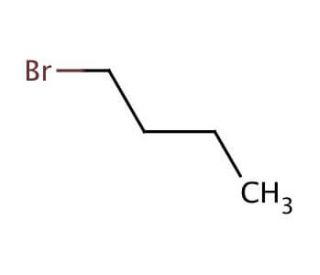

1-Bromobutane (CAS 109-65-9)
QUICK LINKS
1-Bromobutane functions as an alkylating agent in organic synthesis. It is used as an alkylating agent in nucleophilic substitution reactions, where it reacts with nucleophiles to form new carbon-carbon bonds. 1-Bromobutane′s mechanism of action involves the displacement of the bromine atom by a nucleophile, resulting in the formation of a new carbon-nucleophile bond. This reaction is utilized in the synthesis of various organic compounds. 1-Bromobutane serves as a precursor for the introduction of the butyl group into organic molecules, allowing for the modification and functionalization of specific chemical structures. Its ability to undergo nucleophilic substitution reactions may be useful in the development of new organic compounds and materials.
1-Bromobutane (CAS 109-65-9) References
- Surface behavior of the 1-bromobutane with isomeric butanol mixtures. | Giner, B., et al. 2005. J Phys Chem B. 109: 23096-102. PMID: 16854008
- Validated methods for degrading hazardous chemicals: some halogenated compounds. | Lunn, G. and Sansone, EB. 1991. Am Ind Hyg Assoc J. 52: 252-7. PMID: 1858668
- Reichardt's dye and its reactions with the alkylating agents 4-chloro-1-butanol, ethyl methanesulfonate, 1-bromobutane and Fast Red B - a potentially useful reagent for the detection of genotoxic impurities in pharmaceuticals. | Corrigan, DK., et al. 2009. J Pharm Pharmacol. 61: 533-7. PMID: 19298702
- Role of glutathione conjugation in 1-bromobutane-induced hepatotoxicity in mice. | Lee, SK., et al. 2010. Food Chem Toxicol. 48: 2707-11. PMID: 20600521
- Substrate specificity of haloalkane dehalogenases. | Koudelakova, T., et al. 2011. Biochem J. 435: 345-54. PMID: 21294712
- Cloning, functional expression, biochemical characterization, and structural analysis of a haloalkane dehalogenase from Plesiocystis pacifica SIR-1. | Hesseler, M., et al. 2011. Appl Microbiol Biotechnol. 91: 1049-60. PMID: 21603934
- Yarrowia lipolytica NCIM 3589, a tropical marine yeast, degrades bromoalkanes by an initial hydrolytic dehalogenation step. | Vatsal, A., et al. 2015. Biodegradation. 26: 127-38. PMID: 25708590
- β-Cyclodextrin at the Water/1-Bromobutane Interface: Molecular Insight into Reverse Phase Transfer Catalysis. | Elk, JC. and Benjamin, I. 2015. Langmuir. 31: 5086-92. PMID: 25909764
- Quantification of glycated N-terminal peptide of hemoglobin using derivatization for multiple functional groups of amino acids followed by liquid chromatography/tandem mass spectrometry. | Sakaguchi, Y., et al. 2016. Biomed Chromatogr. 30: 280-4. PMID: 26037490
- Separation of Bromoalkanes Isomers by Nonporous Adaptive Crystals of Leaning Pillar[6]arene. | Wu, JR., et al. 2020. Angew Chem Int Ed Engl. 59: 2251-2255. PMID: 31765068
- Tuning the porosity of triangular supramolecular adsorbents for superior haloalkane isomer separations. | Hua, B., et al. 2021. Chem Sci. 12: 12286-12291. PMID: 34603658
- Negative-mode ion mobility spectrometry-comparison of ion-molecule reactions and electron capture processes. | Budzyńska, E., et al. 2022. Anal Bioanal Chem. 414: 3719-3728. PMID: 35305117
- Some metabolites of 1-bromobutane in the rabbit and the rat. | James, SP., et al. 1968. Biochem J. 109: 727-36. PMID: 5696863
Ordering Information
| Product Name | Catalog # | UNIT | Price | Qty | FAVORITES | |
1-Bromobutane, 25 g | sc-213316 | 25 g | $28.00 | |||
1-Bromobutane, 500 g | sc-213316A | 500 g | $58.00 |