
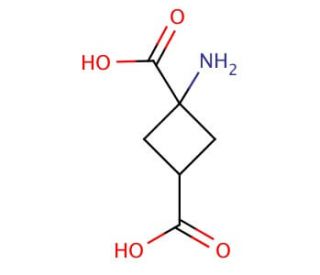

1-Aminocyclobutane-trans-1,3-dicarboxylic acid 의 분자 구조, CAS 번호: 73550-55-7
1-Aminocyclobutane-trans-1,3-dicarboxylic acid (CAS 73550-55-7)
대체 이름:
cis-1-Aminocyclobutane-1,3-dicarboxylic acid; cis-ACBD
적용:
1-Aminocyclobutane-trans-1,3-dicarboxylic acid 는 EAAT의 강력한 억제제입니다.
CAS 등록번호:
73550-55-7
분자량:
159.14
분자식:
C6H9NO4
연구용으로만 사용가능합니다. 진단이나 치료용으로 사용불가합니다.
* 참조분석증명서대량의 측정 데이터(함수량포함).
빠른 링크
주문정보
설명
기술정보
안전정보
SDS 및 분석 증명서
1-Aminocyclobutane-trans-1,3-dicarboxylic acid (CAS 73550-55-7) 참고자료
- 고친화성, 나트륨 의존성 글루타메이트 수송체의 기질 및 비기질 억제제의 분화. | Koch, HP., et al. 1999. Mol Pharmacol. 56: 1095-104. PMID: 10570036
- 글루탐산의 형태적으로 제한된 유사체, 시스-1-아미노사이클로부탄-1,3-디카르복실산에 의한 쥐 피질 시냅토솜으로의 고친화성 L-글루탐산 흡수의 억제. | Fletcher, EJ., et al. 1991. Neurosci Lett. 121: 133-5. PMID: 1673544
- 강력한 N-메틸-D-아스파르트산 작용제, 트랜스-1-아미노사이클로부탄-1,3-디카르복실산 및 관련 포스포닉 및 카르복실산의 합성 및 활성. | Allan, RD., et al. 1990. J Med Chem. 33: 2905-15. PMID: 2145435
- 소포 글루타메이트 수송의 메커니즘과 조절: 시냅스 소포 주기와의 조정. | Eriksen, J., et al. 2020. Biochim Biophys Acta Biomembr. 1862: 183259. PMID: 32147354
- 아데노신 삼인산 고갈은 쥐 해마 절편에서 나트륨 의존적인 글루타메이트의 신경세포 흡수를 역전시킵니다. | Madl, JE. and Burgesser, K. 1993. J Neurosci. 13: 4429-44. PMID: 8105040
- 일차 신경세포 병아리 배양에서 L-글루타메이트와 D-아스파르트산염 방출의 차이. | Lewin, L., et al. 1996. Neurochem Res. 21: 79-85. PMID: 8833227
- L-아스파르트산염-베타-하이드록사메이트에 노출된 후 시냅스 반응의 지속적인 우울증이 퀴스쿼레이트 민감성 해마 절편에서 발생합니다. | Roon, RJ. and Koerner, JF. 1996. Brain Res. 734: 223-8. PMID: 8896828
- 식물 유래 순환 기질에 대한 곤충 Na + 의존성 글루타메이트 수송체의 친화성[J]. | Caveney S, McLean H M, Watson I. 1996. Insect Biochemistry and Molecular Biology,., 26(10):: 1027-1036.
- 가재 신경근 접합부의 EPSP 진폭은 시냅스 틈새의 글루타메이트 농도를 증가시키는 방법에 민감합니다[J]. | Kaler M, Newton J, Simmons K. 2013. Pioneering Neuroscience,., 2:: 45-50.
- 플루옥세틴과 하이퍼포린은 가재 신경근 접합부에서 EPSP 지속 시간을 증가시켜 알려진 글루타메이트 재흡수 억제제처럼 작용하는 것으로 보입니다[J]. | Hoye A, Mitchell D, Tucker A. 2013. Pioneering Neuroscience,., 3:: 41-44.
의 억제제:
EAAT.의 활성화자:
NMDAε1.주문정보
| 제품명 | 카탈로그 번호 | 단위 | 가격 | 수량 | 관심품목 | |
1-Aminocyclobutane-trans-1,3-dicarboxylic acid, 10 mg | sc-361072 | 10 mg | $139.00 | |||
1-Aminocyclobutane-trans-1,3-dicarboxylic acid, 50 mg | sc-361072A | 50 mg | $585.00 |