
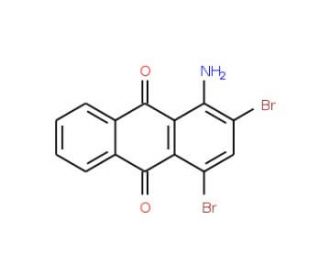

1-Amino-2,4-dibromoanthraquinone (CAS 81-49-2)
QUICK LINKS
1-Amino-2,4-dibromoanthraquinone is valued for its utility in the synthesis of an array of organic molecules, including vibrant dyes and pigments. Its primary function lies in facilitating organic synthesis through mechanisms such as nucleophilic substitution and condensation reactions, which are for crafting complex molecular architectures. In these reactions, 1-Amino-2,4-dibromoanthraquinone typically engages by introducing its amino and dibromo functionalities into new compounds, thereby enriching their chemical diversity. The versatility of 1-Amino-2,4-dibromoanthraquinone extends to its role as a foundational component in the development of innovative materials, playing a critical role in broadening the horizons of chemical exploration and contributing significantly to the advancement of various scientific disciplines by facilitating the discovery and characterization of new chemical entities.
1-Amino-2,4-dibromoanthraquinone (CAS 81-49-2) References
- Reevaluating cancer risk estimates for short-term exposure scenarios. | Halmes, NC., et al. 2000. Toxicol Sci. 58: 32-42. PMID: 11053538
- High frequency of ras mutations in forestomach and lung tumors of B6C3F1 mice exposed to 1-amino-2,4-dibromoanthraquinone for 2 years. | Hayashi, S., et al. 2001. Toxicol Pathol. 29: 422-9. PMID: 11560247
- Characteristics of the spectrum of proliferative lesions observed in the kidney and urinary bladder of Fischer 344 rats and B6C3F1 mice. | Wolf, JC. 2002. Toxicol Pathol. 30: 657-62. PMID: 12512865
- NTP Toxicology and Carcinogenesis Studies of 1-Amino-2,4-Dibromoanthraquinone (CAS No. 81-49-2) in F344/N Rats and B6C3F1 Mice (Feed Studies). | ,. 1996. Natl Toxicol Program Tech Rep Ser. 383: 1-370. PMID: 12692653
- Influence of functional group substitutions on the carcinogenicity of anthraquinone in rats and mice: analysis of long-term bioassays by the National Cancer Institute and the National Toxicology Program. | Doi, AM., et al. 2005. J Toxicol Environ Health B Crit Rev. 8: 109-26. PMID: 15804751
- Combined experimental and theoretical study on photoinduced toxicity of an anthraquinone dye intermediate to Daphnia magna. | Wang, Y., et al. 2009. Environ Toxicol Chem. 28: 846-52. PMID: 19391687
- Use of short-term transcriptional profiles to assess the long-term cancer-related safety of environmental and industrial chemicals. | Thomas, RS., et al. 2009. Toxicol Sci. 112: 311-21. PMID: 19776212
- Predicting the hepatocarcinogenic potential of alkenylbenzene flavoring agents using toxicogenomics and machine learning. | Auerbach, SS., et al. 2010. Toxicol Appl Pharmacol. 243: 300-14. PMID: 20004213
- 1-Amino-2,4-dibromoanthraquinone. | . 2004. Rep Carcinog. 11: III15-6. PMID: 21089801
- 1-Amino-2,4-dibromoanthraquinone. | ,. 2011. Rep Carcinog. 12: 39-41. PMID: 21829245
- Observations on altered hepatocellular foci in National Toxicology Program two-year carcinogenicity studies in rats. | Harada, T., et al. 1989. Toxicol Pathol. 17: 690-706; discussion 707-8. PMID: 2629101
- Disruption of spindle checkpoint function in rats following 28 days of repeated administration of renal carcinogens. | Kimura, M., et al. 2016. J Toxicol Sci. 41: 91-104. PMID: 26763396
- Thirteen-week toxicology studies of 1-amino-2,4-dibromoanthraquinone in Fischer 344/N rats and B6C3F1 mice. | Fleischman, RW., et al. 1986. Toxicol Appl Pharmacol. 82: 389-404. PMID: 3952725
Ordering Information
| Product Name | Catalog # | UNIT | Price | Qty | FAVORITES | |
1-Amino-2,4-dibromoanthraquinone, 50 g | sc-273199 | 50 g | $306.00 |