
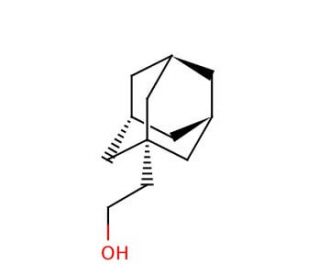

1-Adamantaneethanol (CAS 6240-11-5)
QUICK LINKS
1-Adamantaneethanol, a derivative of the adamantane structure, has garnered significant attention in scientific research due to its unique chemical properties and potential applications in various fields. One area of interest lies in its role as a building block in the synthesis of novel materials. The adamantane moiety imparts steric rigidity and structural stability to the molecule, making 1-adamantaneethanol a valuable precursor for the fabrication of functionalized polymers, dendrimers, and nanomaterials. Researchers exploit its structural features to design and synthesize materials with tailored properties such as enhanced mechanical strength, thermal stability, and chemical resistance. Moreover, 1-adamantaneethanol serves as a versatile starting material for the synthesis of pharmaceutical intermediates and fine chemicals. Its rigid three-dimensional structure and functional groups make it an attractive candidate for the development of new molecules with potential applications in drug discovery and materials science. Additionally, 1-adamantaneethanol has been investigated for its antimicrobial properties, with studies exploring its mechanism of action against various pathogens. Overall, the multifaceted nature of 1-adamantaneethanol makes it a valuable tool in research endeavors aimed at developing innovative materials.
1-Adamantaneethanol (CAS 6240-11-5) References
- Synthesis and antimicrobial activity of new adamantane derivatives II. | Orzeszko, A., et al. 2000. Farmaco. 55: 619-23. PMID: 11152243
- Microcalorimetric study on micellization of nonionic surfactants with a benzene ring or adamantane in their hydrophobic chains. | Li, Y., et al. 2005. J Phys Chem B. 109: 16070-4. PMID: 16853041
- Identification of a highly potent vitamin D receptor antagonist: (25S)-26-adamantyl-25-hydroxy-2-methylene-22,23-didehydro-19,27-dinor-20-epi-vitamin D3 (ADMI3). | Igarashi, M., et al. 2007. Arch Biochem Biophys. 460: 240-53. PMID: 17214957
- Effective switch-on fluorescence sensing of zinc(II) ion by 8-aminoquinolino-beta-cyclodextrin/adamantaneacetic acid system in water. | Chen, Y., et al. 2007. Bioorg Med Chem. 15: 4537-42. PMID: 17467997
- Temperature sensitive supramolecular self assembly of per-6-PEO-β-cyclodextrin and α,ω-di-(adamantylethyl)poly(N-isopropylacrylamide) in water. | Bennevault, V., et al. 2015. Soft Matter. 11: 6432-43. PMID: 26179328
- Probing Lipophilic Adamantyl Group as the P1-Ligand for HIV-1 Protease Inhibitors: Design, Synthesis, Protein X-ray Structural Studies, and Biological Evaluation. | Ghosh, AK., et al. 2016. J Med Chem. 59: 6826-37. PMID: 27389367
- Superstructures with diverse morphologies and highly ordered fullerene C60 arrays from 1 : 1 and 2 : 1 adamantane-C60 hybrid molecules. | Zhou, S., et al. 2017. Nanoscale. 9: 16375-16385. PMID: 29053163
- Synthesis and characterization of the first adamantane-based poly (p-phenylenevinylene) derivative: an intelligent plastic for smart electronic displays[J]. | Jeong H Y, Lee Y K, Talaie A. 2002. Thin Solid Films,., 417(1-2):: 171-174.
- Adamantyl modified silica via olefin hydrosilation on a hydride intermediate[J]. | Matyska M T, Pesek J J, Tong S. 2003,. Journal of liquid chromatography & related technologies,. 26(8):: 1169-1196.
- Highly photostable silicon (IV) phthalocyanines containing adamantane moieties: synthesis, structure, and properties[J]. | Shen X M, Jiang X J, Huang C C. 2010,. Tetrahedron,. 66(46):: 9041-9048.
Ordering Information
| Product Name | Catalog # | UNIT | Price | Qty | FAVORITES | |
1-Adamantaneethanol, 1 g | sc-222649 | 1 g | $38.00 | |||
1-Adamantaneethanol, 5 g | sc-222649A | 5 g | $152.00 |