
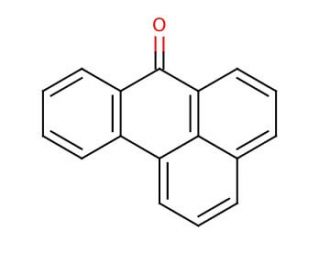

1,9-Benz-10-anthrone (CAS 82-05-3)
Direktverknüpfungen
1,9-Benz-10-anthron ist ein gelbliches Pulver, das sich in organischen Lösungsmitteln wie Aceton, Chloroform und Ethylacetat löst, aber nicht wasserlöslich ist. Es hat eine Vielzahl von Anwendungen in Industrie und wissenschaftlicher Forschung, einschließlich als Rohstoff für Farbstoffe und Pigmente und als analytisches Reagenz. Die Verbindung wird oft als Referenzstandard in HPLC- und GC-MS-Analysen verwendet. Ihre photophysikalischen Eigenschaften wurden gründlich untersucht, was sie zu einem Benchmark für die Untersuchung intermolekularer Wasserstoffbrückenbindungen und der Absorption von Wasserdampf in organischen Substanzen macht. Darüber hinaus ist Benzanthron chemisch vielseitig und kann an verschiedenen Reaktionen wie Oxidation und Reduktion teilnehmen.
1,9-Benz-10-anthrone (CAS 82-05-3) Literaturhinweise
- Maximierung der chromatographischen Informationen aus Umweltextrakten durch GCxGC-ToF-MS. | Skoczyńska, E., et al. 2008. Environ Sci Technol. 42: 6611-8. PMID: 18800538
- Vergleichende Entwicklungstoxizität von umweltrelevanten sauerstoffhaltigen PAHs. | Knecht, AL., et al. 2013. Toxicol Appl Pharmacol. 271: 266-75. PMID: 23684558
- Ligandenspezifische Transkriptionsmechanismen liegen der durch den Aryl-Kohlenwasserstoff-Rezeptor vermittelten Entwicklungstoxizität sauerstoffhaltiger PAK zugrunde. | Goodale, BC., et al. 2015. Toxicol Sci. 147: 397-411. PMID: 26141390
- Zeit- und ölabhängige transkriptomische und physiologische Reaktionen auf Deepwater Horizon Öl in Mahi-Mahi (Coryphaena hippurus) Embryonen und Larven. | Xu, EG., et al. 2016. Environ Sci Technol. 50: 7842-51. PMID: 27348429
- Biorisanamento di terreni contaminati da IPA: Conseguenze sulla formazione e sulla degradazione dei composti aromatici polar-policiclici e sull'abbondanza della comunità microbica. | Biache, C., et al. 2017. J Hazard Mater. 329: 1-10. PMID: 28119192
- Mechanistische Untersuchungen zur Entwicklungstoxizität von nitrierten und heterozyklischen PAHs. | Chlebowski, AC., et al. 2017. Toxicol Sci. 157: 246-259. PMID: 28186253
- Larven der Roten Trommel (Sciaenops ocellatus) sind subletal verwittertem Deepwater Horizon Rohöl ausgesetzt: Entwicklungs- und transkriptomische Folgen. | Xu, EG., et al. 2017. Environ Sci Technol. 51: 10162-10172. PMID: 28768411
- AHR2 wird für normale Verhaltensreaktionen und die richtige Entwicklung des Skelett- und Fortpflanzungssystems bei Zebrafischen benötigt. | Garcia, GR., et al. 2018. PLoS One. 13: e0193484. PMID: 29494622
- Jenseits des Offensichtlichen: Auswirkungen polarer polyzyklischer aromatischer Kohlenwasserstoffe auf die Umwelt und die Gesundheit. | Idowu, O., et al. 2019. Environ Int. 123: 543-557. PMID: 30622079
- Ein Überblick über die funktionelle Rolle der Arylkohlenwasserstoffrezeptoren des Zebrafisches. | Shankar, P., et al. 2020. Toxicol Sci. 178: 215-238. PMID: 32976604
- Integrierte analytische und computergestützte Werkzeuge zur Strukturaufklärung bei der wirkungsorientierten Analyse | Schymanski, E. L., Bataineh, M., Goss, K. U., & Brack, W. 2009. TrAC Trends in Analytical Chemistry. 28(5): 550-561.
- Charakterisierung von organischen Verunreinigungen in der arktischen Luft - Teil 2: Anwendung eines neuen Instruments zur Identifizierung und Priorisierung von Chemikalien, die in der Arktis als bedenklich gelten | Röhler, L., Schlabach, M., Haglund, P., Breivik, K., Kallenborn, R., & Bohlin-Nizzetto, P. 2020. Atmospheric Chemistry and Physics. 20(14): 9031-9049.
Bestellinformation
| Produkt | Katalog # | EINHEIT | Preis | ANZAHL | Favoriten | |
1,9-Benz-10-anthrone, 5 g | sc-237803 | 5 g | $60.00 |