
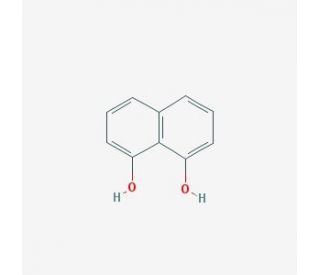

1,8-Naphthalenediol (CAS 569-42-6)
QUICK LINKS
1,8-Naphthalenediol (ND) is an organic compound which is insoluble in water but dissolvable in various organic solvents. It has been a staple in the production of dyes, plastics, and has seen use as a preservative in certain food items, as well as a component in perfumes. In scientific research, 1,8-Naphthalenediol′s versatility is highlighted through its role as a reagent in chemical syntheses and as an agent in biochemical and physiological studies. Its application extends to exploring enzyme kinetics, protein-ligand interactions, and the metabolism of drugs. 1,8-Naphthalenediol acts by inhibiting specific enzymes, including the cytochrome P450 enzymes, which play a significant part in the metabolic process of various substances, thereby influencing their biochemical and physiological behaviors. This property of 1,8-Naphthalenediol also makes it valuable in the study of the impact of environmental pollutants on health.
1,8-Naphthalenediol (CAS 569-42-6) References
- Naphthalene diols: a new class of antioxidants intramolecular hydrogen bonding in catechols, naphthalene diols, and their aryloxyl radicals. | Foti, MC., et al. 2002. J Org Chem. 67: 5190-6. PMID: 12126405
- Ferromagnetic coupling by orthogonal magnetic orbitals in a heterodinuclear CuIIVIV=O complex and in a homodinuclear CuIICuII complex. | Glaser, T., et al. 2006. Inorg Chem. 45: 4889-91. PMID: 16780307
- A trinucleating ligand based on 1,8-naphthalenediol: synthesis, structural and magnetic properties of a linear Cu(II)Cu(II)Cu(II) complex. | Glaser, T., et al. 2007. Chem Commun (Camb). 356-8. PMID: 17220969
- Structures and magnetic properties of dysprosium complexes: the effect of crystallization temperature. | Guo, M., et al. 2017. Dalton Trans. 46: 564-570. PMID: 27977026
- Characterization and Fate of Hydrogen-Bonded Free-Radical Intermediates and Their Coupling Products from the Hydrogen Atom Transfer Agent 1,8-Naphthalenediol. | Manini, P., et al. 2018. ACS Omega. 3: 3918-3927. PMID: 31458630
- Boronic, diboronic and boric acid esters of 1,8-naphthalenediol - synthesis, structure and formation of boronium salts. | Manankandayalage, CP., et al. 2020. Dalton Trans. 49: 4834-4842. PMID: 32215427
- Proof of Phosphate Diester Binding Ability of Cytotoxic DNA-Binding Complexes. | Simon, J., et al. 2020. Inorg Chem. 59: 14615-14619. PMID: 32975115
- Evaluation of the binding mode of a cytotoxic dinuclear nickel complex to two neighboring phosphates of the DNA backbone. | Simon, J., et al. 2022. Dalton Trans. 51: 2863-2875. PMID: 35098951
- Ring-hydroxylated propranolol: synthesis and beta-receptor antagonist and vasodilating activities of the seven isomers. | Oatis, JE., et al. 1981. J Med Chem. 24: 309-14. PMID: 6115057
Ordering Information
| Product Name | Catalog # | UNIT | Price | Qty | FAVORITES | |
1,8-Naphthalenediol, 10 g | sc-334249 | 10 g | $394.00 |