
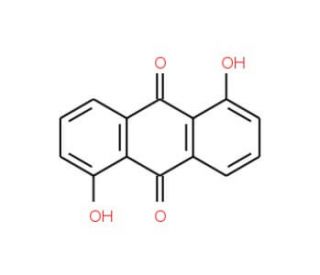

1,5-Dihydroxyanthraquinone (CAS 117-12-4)
QUICK LINKS
1,5-Dihydroxyanthraquinone is an occurring organic compound found in various plants, lichens, and fungi. It is a derivative of anthraquinone, which is a type of aromatic organic compound. In biochemistry, 1,5-dihydroxyanthraquinone is of interest due to its potential as a precursor for the synthesis of various bioactive molecules. It has been studied for its antioxidant properties and its ability to inhibit certain enzymes. 1,5-dihydroxyanthraquinone has been investigated for its potential as a dye in biological staining techniques. Its chemical structure and reactivity make it useful in the study of various biochemical processes. In the laboratory, it is used as a reagent in organic synthesis and as a model compound for studying the behavior of similar molecules in biological systems. 1,5-dihydroxyanthraquinone plays a role in the field of biochemistry as a versatile compound with potential applications.
1,5-Dihydroxyanthraquinone (CAS 117-12-4) References
- Interaction of anthracene and its oxidative derivatives with human serum albumin. | Skupińska, K., et al. 2006. Acta Biochim Pol. 53: 101-12. PMID: 16404478
- Structure-activity relationships of anthraquinones on the suppression of DNA-binding activity of the aryl hydrocarbon receptor induced by 2,3,7,8-tetrachlorodibenzo-p-dioxin. | Fukuda, I., et al. 2009. J Biosci Bioeng. 107: 296-300. PMID: 19269596
- A highly selective dual mode detection of Fe3+ ion sensing based on 1,5-dihydroxyanthraquinone in the presence of β-cyclodextrin. | Mohandoss, S., et al. 2015. Mater Sci Eng C Mater Biol Appl. 48: 94-102. PMID: 25579901
- Structure-Antioxidative and Anti-Inflammatory Activity Relationships of Purpurin and Related Anthraquinones in Chemical and Cell Assays. | Nam, W., et al. 2017. Molecules. 22: PMID: 28208613
- The Inhibitory Activity of Anthraquinones against Pathogenic Protozoa, Bacteria, and Fungi and the Relationship to Structure. | Friedman, M., et al. 2020. Molecules. 25: PMID: 32646028
- Dual Molecules Cooperatively Confined In-Between Edge-oxygen-rich Graphene Sheets as Ultrahigh Rate and Stable Electrodes for Supercapacitors. | Qiu, Z., et al. 2023. Small. e2302316. PMID: 37119477
- Antitumor agents, 75. Synthesis of cytotoxic anthraquinones digiferruginol and morindaparvin-B. | Chang, P. and Lee, KH. 1985. J Nat Prod. 48: 948-51. PMID: 3841556
- Comparison of effects of 1,8-dihydroxyanthraquinone and 1,5-dihydroxyanthraquinone on different segments of rabbit gastrointestinal tract. | Eickholt, TH., et al. 1970. J Pharm Sci. 59: 1518-20. PMID: 5482415
- Polarization Dependence of Absorption and Luminescence Spectra of a 1,5-Dihydroxyanthraquinone Single Crystal | N Namsrai, T Yoshinari, H Itoh, S Nagasaka… - Journal of the Physical …, 2006 - journals.jps.jp. (2006). J. Phys. Soc. Jpn. 75,: 044703.
- Intramolecular hydrogen bonding. 4. Dual fluorescence and excited-state proton transfer in 1,5-dihydroxyanthraquinone | Mark H. Van Benthem and G. D. Gillispie. 1984. J. Phys. Chem., 88, 14,: 2954–2960.
- Surface-enhanced Raman scattering of 1,5-dihydroxyanthraquinone in silver sol | SE Jayaraj, V Ramakrishnan - Spectrochimica Acta Part A: Molecular and …, 1995 - Elsevier. June 1995,. Spectrochimica Acta Part A: Molecular and Biomolecular Spectroscopy. Volume 51, Issue 6,: Pages 979-983.
- A novel anode modified by 1,5-dihydroxyanthraquinone/multiwalled carbon nanotubes composite in marine sediment microbial fuel cell and its electrochemical performance | Haoshuang Zhang, Yubin Fu, Changyang Zhou, Shuang Liu, Minggang Zhao, Tonglai Chen, Xuerong Zai. June 2018. International Journal of Energy Research. Volume42, Issue7 10: Pages 2574-2582.
Ordering Information
| Product Name | Catalog # | UNIT | Price | Qty | FAVORITES | |
1,5-Dihydroxyanthraquinone, 10 g | sc-253997 | 10 g | $37.00 | |||
1,5-Dihydroxyanthraquinone, 100 g | sc-253997A | 100 g | $72.00 |