
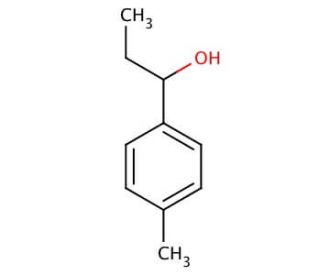

1-(4-Methylphenyl)-1-propanol (CAS 25574-04-3)
QUICK LINKS
1-(4-Methylphenyl)-1-propanol, also referred to as p-methylphenylpropanol, is an alcohol compound categorized within the class of alcohols. It finds common utilization in scientific research, particularly in the fields of biochemistry and physiology. It serves as a chiral auxiliary in asymmetric synthesis and a chiral ligand in asymmetric catalysis. Additionally, it has found application as a flavoring agent within the food industry. The precise mechanism of action of 1-(4-Methylphenyl)-1-propanol remains largely unelucidated. However, it is believed to interact with specific receptors in the brain, influencing neurotransmitter release and subsequently impacting behavior. Studies conducted on animal models have demonstrated its anxiolytic and sedative effects, along with its anticonvulsant properties. Furthermore, it has exhibited anti-inflammatory characteristics and displayed a capacity to shield against oxidative stress.
1-(4-Methylphenyl)-1-propanol (CAS 25574-04-3) References
- Easily recyclable chiral polymeric Mn(III) salen complexes for oxidative kinetic resolution of racemic secondary alcohols. | Kureshy, RI., et al. 2007. Chirality. 19: 352-7. PMID: 17354262
- Aroma profile of star anise and the structure-odor relationship of anethole. | Hasegaw, T., et al. 2014. Nat Prod Commun. 9: 251-6. PMID: 24689303
- Aza-crown compounds synthesised by the self-condensation of 2-amino-benzyl alcohol over a pincer ruthenium catalyst and applied in the transfer hydrogenation of ketones. | Zhang, S., et al. 2020. Dalton Trans. 49: 15821-15827. PMID: 33151229
- The measurement of enantiopurity using phosphorus-NMR | Christopher J Welch. 1991. Tetrahedron: Asymmetry. 2(11): 1127-1132.
- An l-proline-based β-amino tertiary thiol: synthesis and use as a catalyst in the enantioselective addition of diethylzinc to aldehydes | Colin L Gibson. 1999. Tetrahedron: Asymmetry. 10(8): 1551-1561.
- New Chiral Ligands Derived from (S)-Leucine for the Enantioselective Addition of Diethylzinc to Aldehydes | Y Kawanami, T Mitsuie, M Miki, T Sakamoto. 2000. Tetrahedron. 56(2): 175-178.
- The role of the planar chirality of iron tricarbonyl substituted homochiral amino alcohols in the asymmetric alkylation of aldehydes with diethylzinc | K Okamoto, T Kimachi, T Ibuka, Y Takemoto. 2001. Tetrahedron: Asymmetry. 12(3): 463-467.
- Asymmetric reaction of diethylzinc with aldehydes catalyzed by l-menthopyrazole derivatives | and Choji Kashima, Kohei Higashide, Yohei Miwa, Yoshihiro Tsukamoto. 2002. Heterocyclic chemistry. 39(5): 917-925.
- A new chiral sulfonamide ligand based on tartaric acid: synthesis and application in the enantioselective addition of diethylzinc to aldehydes and ketones | A Hui, J Zhang, J Fan, Z Wang. 2006. Tetrahedron: Asymmetry. 17(14): 2101-2107.
- Cyclometalated palladium pre-catalyst for N-alkylation of amines using alcohols and regioselective alkylation of sulfanilamide using aryl alcohols | R Mamidala, V Mukundam, K Dhanunjayarao. 2017. Tetrahedron. 73(16): 2225-2233.
- Essential meaning of high pressure measurements in discerning the properties of monohydroxy alcohols with a single phenyl group | S Kołodziej, J Knapik-Kowalczuk, K Grzybowska. 2020. Journal of Molecular Liquids. 305: 112863.
Ordering Information
| Product Name | Catalog # | UNIT | Price | Qty | FAVORITES | |
1-(4-Methylphenyl)-1-propanol, 1 g | sc-222573 | 1 g | $51.00 | |||
1-(4-Methylphenyl)-1-propanol, 5 g | sc-222573A | 5 g | $153.00 |