
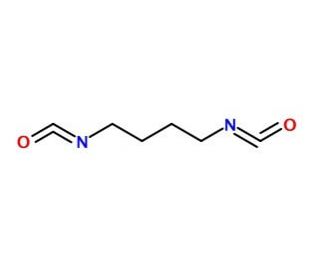

1,4-Diisocyanatobutane (CAS 4538-37-8)
QUICK LINKS
1,4-Diisocyanatobutane, also known as 1,4-DIB, is an extremely reactive organic compound that has numerous industrial uses. Its main function is in the creation of polyurethanes, polyureas, and other polymers. Beyond that, 1,4-Diisocyanatobutane is employed in the creation of substances used in agriculture, and various other chemical compounds. This compound is a colorless liquid, characterized by a low boiling point and a potent odor. Its wide usage in scientific research includes the synthesis of polymers, substances used in agriculture, and more. It′s also used to create organic and inorganic compounds, including dyes, pigments, and catalysts. As a highly reactive compound, 1,4-Diisocyanatobutane readily undergoes a multitude of reactions. It can react with water to form a hydroxy-terminated polyurethane, and with amines to create polyureas. Additionally, it can react with alcohols and phenols, as well as with aldehydes, ketones, and carboxylic acids to form polyurethanes.
1,4-Diisocyanatobutane (CAS 4538-37-8) References
- Fabrication of biodegradable elastomeric scaffolds with sub-micron morphologies. | Stankus, JJ., et al. 2004. J Biomed Mater Res A. 70: 603-14. PMID: 15307165
- Preparation and characterization of highly porous, biodegradable polyurethane scaffolds for soft tissue applications. | Guan, J., et al. 2005. Biomaterials. 26: 3961-71. PMID: 15626443
- Microintegrating smooth muscle cells into a biodegradable, elastomeric fiber matrix. | Stankus, JJ., et al. 2006. Biomaterials. 27: 735-44. PMID: 16095685
- Development of composite porous scaffolds based on collagen and biodegradable poly(ester urethane)urea. | Guan, J., et al. 2006. Cell Transplant. 15 Suppl 1: S17-27. PMID: 16826792
- Fabrication of cell microintegrated blood vessel constructs through electrohydrodynamic atomization. | Stankus, JJ., et al. 2007. Biomaterials. 28: 2738-46. PMID: 17337048
- Synthesis and characterization of segmented poly(esterurethane urea) elastomers for bone tissue engineering. | Kavlock, KD., et al. 2007. Acta Biomater. 3: 475-84. PMID: 17418651
- Tailoring the degradation kinetics of poly(ester carbonate urethane)urea thermoplastic elastomers for tissue engineering scaffolds. | Hong, Y., et al. 2010. Biomaterials. 31: 4249-58. PMID: 20188411
- Characterization of the complete fiber network topology of planar fibrous tissues and scaffolds. | D'Amore, A., et al. 2010. Biomaterials. 31: 5345-54. PMID: 20398930
- Controlled release of IGF-1 and HGF from a biodegradable polyurethane scaffold. | Nelson, DM., et al. 2011. Pharm Res. 28: 1282-93. PMID: 21347565
- Degradable segmented polyurethane elastomers for bone tissue engineering: effect of polycaprolactone content. | Kavlock, KD., et al. 2013. J Biomater Sci Polym Ed. 24: 77-93. PMID: 22304961
- Synthesis, characterization, and paclitaxel release from a biodegradable, elastomeric, poly(ester urethane)urea bearing phosphorylcholine groups for reduced thrombogenicity. | Hong, Y., et al. 2012. Biomacromolecules. 13: 3686-94. PMID: 23035885
- Gelatin-modified polyurethanes for soft tissue scaffold. | Kucińska-Lipka, J., et al. 2013. ScientificWorldJournal. 2013: 450132. PMID: 24363617
- Novel Poly(3-hydroxybutyrate-g-vinyl alcohol) Polyurethane Scaffold for Tissue Engineering. | Reyes, AP., et al. 2016. Sci Rep. 6: 31140. PMID: 27502732
Ordering Information
| Product Name | Catalog # | UNIT | Price | Qty | FAVORITES | |
1,4-Diisocyanatobutane, 1 g | sc-253989 | 1 g | $129.00 | |||
1,4-Diisocyanatobutane, 5 g | sc-253989A | 5 g | $490.00 | |||
1,4-Diisocyanatobutane, 50 g | sc-253989B | 50 g | $983.00 | |||
1,4-Diisocyanatobutane, 500 g | sc-253989C | 500 g | $3779.00 |