
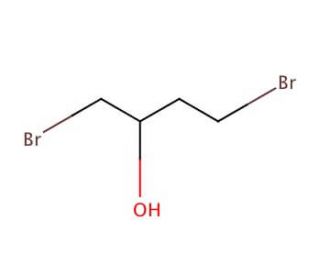

1,4-Dibromo-2-butanol (CAS 19398-47-1)
QUICK LINKS
1,4-Dibromo-2-butanol, a brominated alcohol compound, has garnered significant attention in scientific research due to its diverse applications in organic synthesis and chemical biology. One of its prominent mechanisms of action lies in its role as a versatile building block for the synthesis of various organic compounds. Through nucleophilic substitution reactions, the brominated alcohol functionality facilitates the introduction of diverse functional groups, enabling the synthesis of complex molecules and pharmaceutical intermediates. Moreover, 1,4-Dibromo-2-butanol has been utilized in the development of novel materials, such as polymers and dendrimers, owing to its reactivity and ability to undergo controlled polymerization processes. Additionally, researchers have explored its use as a precursor for the synthesis of biologically active compounds, including potential drug candidates and agrochemicals. Its unique structural features, including the presence of bromine atoms and hydroxyl groups, render it amenable to various synthetic transformations, contributing to its widespread use in organic chemistry research. Ongoing studies continue to investigate novel synthetic methodologies and applications of 1,4-Dibromo-2-butanol, highlighting its importance as a valuable reagent in both academic and industrial research settings.
1,4-Dibromo-2-butanol (CAS 19398-47-1) References
- Determination of halogenated mono-alcohols and diols in water by gas chromatography with electron-capture detection. | Matthew, BM. and Anastasio, C. 2000. J Chromatogr A. 866: 65-77. PMID: 10681010
- Biochemical characterization of broad-specificity enzymes using multivariate experimental design and a colorimetric microplate assay: characterization of the haloalkane dehalogenase mutants. | Marvanová, S., et al. 2001. J Microbiol Methods. 44: 149-57. PMID: 11165344
- Non-classical antifolates, 5-(N-phenylpyrrolidin-3-yl)-2,4,6-triaminopyrimidines and 2,4-Diamino-6(5H)-oxopyrimidines, synthesis and antitumor studies. | Huang, YL., et al. 2003. Bioorg Med Chem. 11: 145-57. PMID: 12467717
- Automated solid phase extraction and quantitative measurement of 2,3-dibromo-1-propanol in urine using gas chromatography-mass spectrometry. | De Alwis, GK., et al. 2007. Arch Environ Contam Toxicol. 53: 134-9. PMID: 17396210
- Color changing block copolymer films for chemical sensing of simple sugars. | Ayyub, OB., et al. 2011. Biosens Bioelectron. 28: 349-54. PMID: 21820888
- Inter- and intramolecular annulation strategies to a cyclopentanone building block containing an all-carbon quaternary stereogenic center. | Penrose, SD., et al. 2015. Org Lett. 17: 1401-4. PMID: 25720587
- Synthesis and characterization of copper (II) complexes with 1, 4-diamino-3-butanol[J]. | Murase I, Ueno S, Kida S. 1984. Inorganica chimica acta,., 87(2):: 155-157.
- QSAR for acute toxicity of saturated and unsaturated halogenated aliphatic compounds[J]. | Bláha L, Damborský J, Němec M., 1998,. Chemosphere. 36(6):: 1345-1365.
- Investigation of 1-bromo-3-buten-2-one as building block in organic synthesis[J]. | Westerlund A, Gras J L, Carlson R. 2001. Tetrahedron,., 57(27):: 5879-5883.
- Synthesis of cyclic disulfides using didecyldimethylammonium bromide as phase transfer catalyst[J]. | Sonavane S U, Chidambaram M, Khalil S,. 2008,. Tetrahedron Letters,. 49(3):: 520-522.
Ordering Information
| Product Name | Catalog # | UNIT | Price | Qty | FAVORITES | |
1,4-Dibromo-2-butanol, 5 g | sc-223031 | 5 g | $46.00 | |||
1,4-Dibromo-2-butanol, 25 g | sc-223031A | 25 g | $165.00 |