
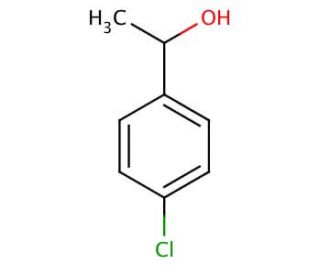

1-(4-Chlorophenyl)ethanol (CAS 3391-10-4)
QUICK LINKS
1-(4-Chlorophenyl)ethanol, a chemical compound with a phenyl ring substituted by a chlorine atom and an alcohol functional group, has been extensively studied for its versatile applications in organic synthesis and materials science. In research, this compound serves as a valuable building block for the synthesis of various organic molecules, particularly in the development of pharmaceutical intermediates, agrochemicals, and functional materials. Its synthesis typically involves the reaction of 4-chlorobenzaldehyde with ethylmagnesium bromide followed by a subsequent reduction to yield the desired alcohol. Furthermore, 1-(4-Chlorophenyl)ethanol has been utilized as a chiral auxiliary in asymmetric synthesis, enabling the control of stereochemistry in reactions and facilitating the production of enantiomerically pure compounds. Additionally, it has found applications in the synthesis of bioactive compounds and the development of novel materials with tailored properties. The chlorophenyl group provides opportunities for further functionalization, allowing researchers to explore a wide range of chemical transformations and expand the scope of its applications in diverse research fields, including organic chemistry, catalysis, and materials science.
1-(4-Chlorophenyl)ethanol (CAS 3391-10-4) References
- Regulating the catalytic activity of multi-Ru-bridged polyoxometalates based on differential active site environments with six-coordinate geometry and five-coordinate geometry transitions. | Li, H., et al. 2021. Nanoscale. 13: 8077-8086. PMID: 33899868
- Ru(III) -based polyoxometalate tetramers as highly efficient heterogeneous catalysts for alcohol oxidation reactions at room temperature. | Zou, Y., et al. 2021. Dalton Trans. 50: 12664-12673. PMID: 34545885
- A chiral porous organic polymer COP-1 used as stationary phase for HPLC enantioseparation under normal-phase and reversed-phase conditions. | Yang, YP., et al. 2022. Mikrochim Acta. 189: 360. PMID: 36042107
- Chiral-induced synthesis of chiral covalent organic frameworks core-shell microspheres for HPLC enantioseparation. | Liu, C., et al. 2024. Mikrochim Acta. 191: 281. PMID: 38649632
- Synthesis of three new cyclodextrin derivatives and their application as chiral stationary phases in the determination of optical purity by capillary gas chromatography. | Shi, X. Y.,. 2002. Chromatographia. 55: 755-759.
- Screening of liver acetone powders in the resolution of 1-phenylethanols and 1-phenylpropanols derivatives[J]. | Solís A, García S, Pérez H I,. 2008. Tetrahedron: Asymmetry,., 19(5):: 549-553.
- Quantitative structure enantioselective retention relationship for high-performance liquid chromatography chiral separation of 1-phenylethanol derivatives[J]. | Szaleniec M, Dudzik A, Pawul M,. 2009. Journal of Chromatography A,. 1216(34): 6224-6235.
- Substituent Effect on Catalytic Activities of [{η5‐Ar4C4COC ( O) Ar} Ru (CO) 2Cl] in Racemization and DKR of Secondary Alcohols. | Lee, ** Hee,. 2011. ChemCatChem. 3.2: 354-359.
Ordering Information
| Product Name | Catalog # | UNIT | Price | Qty | FAVORITES | |
1-(4-Chlorophenyl)ethanol, 25 g | sc-222555 | 25 g | $112.00 |