
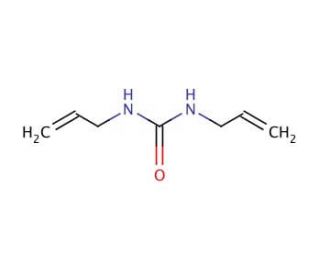

1,3-Diallylurea (CAS 1801-72-5)
QUICK LINKS
1,3-Diallylurea is a compound frequently investigated in polymer research due to its potential as a cross-linking agent, which can impact the mechanical properties of polymers. Studies often focus on its ability to enhance the thermal stability and rigidity of polymeric materials when incorporated into their structure. By reacting with other monomers or pre-polymers, 1,3-Diallylurea forms bridges between polymer chains, which is of particular interest in the creation of thermosetting plastics. Its role in the synthesis of polyurethane foams is also examined, as it may contribute to the final foam′s characteristics such as density, porosity, and resilience. Additionally, research into the reactivity of 1,3-Diallylurea with various chemical groups furthers the understanding of its potential applications in the design of novel materials with specific desired properties.
1,3-Diallylurea (CAS 1801-72-5) References
- Thiol-click chemistries for responsive neural interfaces. | Ware, T., et al. 2013. Macromol Biosci. 13: 1640-7. PMID: 24115484
- A novel cell-permeable, selective, and noncompetitive inhibitor of KAT3 histone acetyltransferases from a combined molecular pruning/classical isosterism approach. | Milite, C., et al. 2015. J Med Chem. 58: 2779-98. PMID: 25730130
- Application of Thiol-yne/Thiol-ene Reactions for Peptide and Protein Macrocyclizations. | Wang, Y., et al. 2017. Chemistry. 23: 7087-7092. PMID: 28345248
- The First MS-Cleavable, Photo-Thiol-Reactive Cross-Linker for Protein Structural Studies. | Iacobucci, C., et al. 2019. J Am Soc Mass Spectrom. 30: 139-148. PMID: 29679287
- Molecular Details of Retinal Guanylyl Cyclase 1/GCAP-2 Interaction. | Rehkamp, A., et al. 2018. Front Mol Neurosci. 11: 330. PMID: 30283299
- Stapled Helical Peptides Bearing Different Anchoring Residues. | Li, X., et al. 2020. Chem Rev. 120: 10079-10144. PMID: 32794722
- Photo-induced radical thiol-ene chemistry: a versatile toolbox for peptide-based drug design. | Ahangarpour, M., et al. 2021. Chem Soc Rev. 50: 898-944. PMID: 33404559
- Cross-Linking Mass Spectrometry for Investigating Protein Conformations and Protein-Protein Interactions─A Method for All Seasons. | Piersimoni, L., et al. 2022. Chem Rev. 122: 7500-7531. PMID: 34797068
- Influence of age of host on the chemotherapy of murine myeloma LCP-1. | Teller, MN., et al. 1974. J Gerontol. 29: 360-5. PMID: 4833754
- Combination chemotherapy of advanced murine myeloma and subsequent resistance to tumor cell challenge. | Teller, MN., et al. 1974. J Natl Cancer Inst. 52: 667-71. PMID: 4857022
- Synthesis of potential anticancer agents. 38. N-Nitrosoureas. 4. Further synthesis and evaluation of haloethyl derivatives. | Johnston, TP., et al. 1971. J Med Chem. 14: 600-14. PMID: 5170822
- Effect of 1, 3-diallylurea and related compounds on growth of transplanted animal tumors. | Tarnowski, GS., et al. 1967. Cancer Res. 27: 1092-5. PMID: 5229785
- Plasma cell tumors in experimental chemotherapy: consequence of dose variation on host survival and paraprotein synthesis. | Teller, MN., et al. 1970. J Natl Cancer Inst. 45: 1197-203. PMID: 5488064
Ordering Information
| Product Name | Catalog # | UNIT | Price | Qty | FAVORITES | |
1,3-Diallylurea, 25 g | sc-237715 | 25 g | $630.00 |