
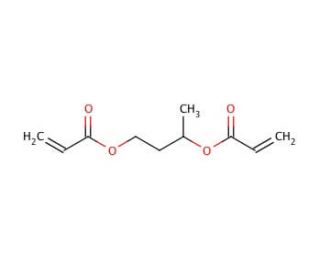

1,3-Butanediol diacrylate (CAS 19485-03-1)
QUICK LINKS
1,3-Butanediol diacrylate (BDD) is an acrylate monomer with high reactivity. 1,3-Butanediol diacrylate finds extensive utility. It serves as a component in polymer synthesis, particularly in the creation of polyacrylates. 1,3-Butanediol diacrylate plays a significant role in the fabrication of nanomaterials, including nanowires and nanotubes. It contributes to the synthesis of various organic compounds, including dyes and pigments. The high reactivity of 1,3-Butanediol diacrylate stems from its ability to establish robust covalent bonds with other molecules. The reaction initiates through the formation of a Lewis acid-base complex, facilitating the creation of a covalent bond between the involved molecules. Completion of the reaction occurs with the addition of a hydrogen atom to the newly formed bond, thereby finalizing 1,3-Butanediol diacrylate (BDD)transformation.
1,3-Butanediol diacrylate (CAS 19485-03-1) References
- Leachability of plasticizer and residual monomer from commercial temporary restorative resins. | Kawahara, T., et al. 2004. J Dent. 32: 277-83. PMID: 15053910
- Development and in situ synthesis of monolithic stationary phases for electrochromatographic separations. | Delaunay-Bertoncini, N., et al. 2004. Electrophoresis. 25: 3204-15. PMID: 15472962
- Development of acrylate-based monolithic stationary phases for electrochromatographic separations. | Barrioulet, MP., et al. 2005. Electrophoresis. 26: 4104-15. PMID: 16252336
- Anisotropic crystal growth in aerosil/polymethylmethacrylate systems dispersed in dimethacrylate monomers. | Pefferkorn, A., et al. 2007. J Colloid Interface Sci. 311: 45-51. PMID: 17382955
- CEC separation of peptides using a poly(hexyl acrylate-co-1,4-butanediol diacrylate-co-[2-(acryloyloxy)ethyl]trimethyl ammonium chloride) monolithic column. | Augustin, V., et al. 2008. Electrophoresis. 29: 3875-86. PMID: 18850656
- Acrylate ester-based monolithic columns for capillary electrochromatography separation of triacylglycerols in vegetable oils. | Lerma-García, MJ., et al. 2011. J Chromatogr A. 1218: 7528-33. PMID: 21737085
- Highly crosslinked polymeric monoliths for reversed-phase capillary liquid chromatography of small molecules. | Liu, K., et al. 2012. J Chromatogr A. 1227: 96-104. PMID: 22265778
- A study of the methylene/perfluormethylene selectivity of porous polymer monolithic stationary phases exhibiting different fluorous/hydrophobic content. | Xu, Z. and Oleschuk, RD. 2014. J Chromatogr A. 1329: 61-70. PMID: 24461637
- Thermal, Mechanical and Biocompatibility Analyses of Photochemically Polymerized PEGDA250 for Photopolymerization-Based Manufacturing Processes. | Rekowska, N., et al. 2022. Pharmaceutics. 14: PMID: 35336002
- Poly(N-ethylmethacrylamide) thermally-sensitive microgel latexes: effect of the nature of the crosslinker on the polymerization kinetics and physicochemical properties | Pascale Hazot a b, Thierry Delair a, Christian Pichot a, Jean-Paul Chapel b, Abdelhamid Elaissari a. 2003. Comptes Rendus Chimie. 6: 1417-1424.
- Conductivity study of diacrylate-based gels: Part III. Influence of the nature of the constituents and improvement of a theoretical model of ionic transport | M Caillon-Caravanier, B Claude-Montigny, D Lemordant, G Bosser. 2003. Solid State Ionics. 156: 113-127.
- Scientific Opinion on the safety evaluation of the substance, (butadiene, styrene, methyl methacrylate, butyl acrylate) copolymer cross-linked with divinylbenzene or 1,3-butanediol dimethacrylate for use in food contact materials | EFSA Panel on food contact materials, enzymes, flavourings and processing aids (CEF). 2011. EFSA Journal. 9.
- PolyHIPE/pullulan composites derived from glycidyl methacrylate and 1,3-butanediol dimethacrylate-based high internal phase emulsions | Funda Çira, Emine Hilal Mert. 2015. Polymer Engineering & Science. 55: 2636-2642.
- Influence of titania on the morphological and mechanical properties of 1,3-butanediol dimethacrylate based polyHIPE composites | Elif Yüce a, Fatma Nur Parın b, Peter Krajnc c, H. Hande Mert d, E. Hilal Mert a. 2018. Reactive and Functional Polymers. 130: 8-15.
- Hydrophilic closed-cell macroporous foam preparation by emulsion templating | Fatma Nur Parın a, E. Hilal Mert b. 2020. Materials Letters. 277.
Ordering Information
| Product Name | Catalog # | UNIT | Price | Qty | FAVORITES | |
1,3-Butanediol diacrylate, 25 ml | sc-222934 | 25 ml | $91.00 |