
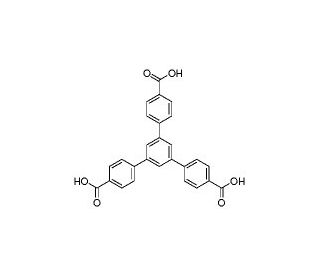

Estructura molecular de 1,3,5-Tris(4-carboxyphenyl)benzene, Número CAS: 50446-44-1
1,3,5-Tris(4-carboxyphenyl)benzene (CAS 50446-44-1)
Solicitud:
1,3,5-Tris(4-carboxyphenyl)benzene es un compuesto de marco metalorgánico
Número de CAS:
50446-44-1
Pureza:
≥98%
Peso Molecular:
438.43
Fórmula Molecular:
C27H18O6
Información suplementaria:
Está clasificada como Mercancía peligrosa para el transporte y puede estar sujeta a gastos de envío adicionales.
Para Uso Exclusivo en Investigación. No está diseñado para uso en diagnosis o terapia.
* En el Certificado de Análisis específico de lote, puede encontrar información específica (como el contenido en agua).
ENLACES RÁPIDOS
Información sobre pedidos
Descripción
Información Técnica
Información de Seguridad
SDS & Certificado de Análisis
El 1,3,5-tris(4-carboxifenil)benceno es un bloque de construcción útil para el ensamblaje de marcos metal-orgánicos. Los materiales fabricados a partir de marcos metal-orgánicos tienen una amplia aplicación y son de especial interés en el diseño de métodos de adsorción de gases, y el 1,3,5-Tris(4-carboxifenil)benceno se ha utilizado en la preparación de materiales para esta aplicación.
1,3,5-Tris(4-carboxyphenyl)benzene (CAS 50446-44-1) Referencias
- Captación excepcional de H2 por saturación en estructuras metal-orgánicas microporosas. | Wong-Foy, AG., et al. 2006. J Am Chem Soc. 128: 3494-5. PMID: 16536503
- Fundamentos de la unión y reactividad del H2 en metales de transición que subyacen a la función de la hidrogenasa y a la producción y almacenamiento de H2. | Kubas, GJ. 2007. Chem Rev. 107: 4152-205. PMID: 17927158
- La comprensión de las inflexiones y los pasos de dióxido de carbono de las isotermas de adsorción de metal-organic frameworks. | Walton, KS., et al. 2008. J Am Chem Soc. 130: 406-7. PMID: 18154291
- Efecto de los Ácidos Tricarboxílicos en la Formación de Hidrogeles con Melem o Melamina: Investigaciones Morfológicas, Estructurales y Reológicas. | Sukul, PK., et al. 2022. Gels. 8: PMID: 35049586
- Síntesis de Estructuras Metal-Orgánicas de Ho3+ y Gd3+ Fluoro-Bridged 1,3,5-Tris(4-carboxifenil)benceno a partir de Sustancias Perfluoroalquiladas. | Sheybani, S., et al. 2023. Inorg Chem. 62: 4314-4321. PMID: 36857778
- Evidencia de Espectroscopia Molecular de la Unión de 1,3,5-Tris(4-carboxifenil)benceno al ADN: Potencial Anticancerígeno junto con el Perfil Comparativo de Unión de la Intercalación mediante Estudios de Modelado. | Wani, TA. and Zargar, S. 2023. Cells. 12: PMID: 37190029
- Una nueva matriz de sensores de múltiples señales de una sola partícula combinada con minería de datos multidimensional para la detección de metabolitos del ciclo del ácido tricarboxílico y la discriminación de células. | Li, J., et al. 2023. Anal Bioanal Chem. 415: 3475-3486. PMID: 37278743
- Síntesis fácil de una nueva nanohoja orgánica covalente (CON-KEY1) basada en enlaces de poliamida como catalizador heterogéneo eficaz en reacciones de acoplamiento cruzado C-C. | Keypour, H., et al. 2023. RSC Adv. 13: 28686-28702. PMID: 37790095
- Manipulación del proceso de autoensamblaje molecular en la interfaz sólido-líquido mediante microscopía de efecto túnel. | Li, Z., et al. 2023. Polymers (Basel). 15: PMID: 37896420
- Diseño racional de redes supramoleculares 2D conmutables mediante campos eléctricos externos. | Cometto, FP., et al. 2024. ACS Nano. 18: 4287-4296. PMID: 38259041
- Capas dipolares robustas entre semiconductores orgánicos y plata para la alineación del nivel de energía. | Krajňák, T., et al. 2024. ACS Appl Mater Interfaces. 16: 18099-18111. PMID: 38551398
- Desarrollos Recientes en Materiales de Marco Metal-Orgánico Basados en Porfirinas para la Remediación del Agua Bajo Irradiación de Luz Visible. | Shee, NK. and Kim, HJ. 2024. Int J Mol Sci. 25: PMID: 38673768
- Síntesis asistida por microondas de nuevos Ti/BTB-MOFs como agentes porosos anticancerígenos y antibacterianos. | Altharawi, A., et al. 2024. Front Chem. 12: 1386311. PMID: 38803382
Información sobre pedidos
| Nombre del producto | Número de catálogo | UNIDAD | Precio | CANTIDAD | Favoritos | |
1,3,5-Tris(4-carboxyphenyl)benzene, 1 g | sc-251591 | 1 g | $227.00 |