
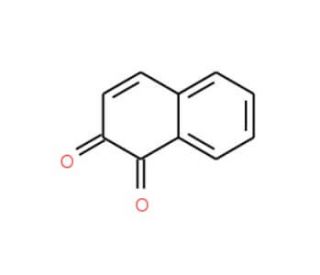

1,2-Naphthoquinone (CAS 524-42-5)
QUICK LINKS
1,2-Naphthoquinone is a useful naphthalene for proteomics research. 1,2-Naphthoquinone serves as a significant metabolite of naphthalene, contributing to its cytotoxicity and genotoxicity. This atmospheric contaminant is responsible for causing the contraction of tracheal smooth muscles in guinea pigs, achieved through the activation of the epidermal growth factor receptor. Moreover, 1,2-Naphthoquinone has been identified as an environmental quinone present in diesel exhaust particles (DEP) and atmospheric particulate matter. This compound presents itself as either golden yellow needles or brown powder and undergoes decomposition to a bluish-black color upon standing. It serves as the foundational structure within the family of 1,2-naphthoquinones, featuring oxo groups of the quinone moiety at positions 1 and 2 of the naphthalene ring. As a metabolite of naphthalene, it can be found in diesel exhaust particles. Its functions include acting as a carcinogenic agent and an aryl hydrocarbon receptor agonist. This specific naphthoquinone is derived from a hydride of a naphthalene compound.
1,2-Naphthoquinone (CAS 524-42-5) References
- [Chemical biology of 1,2-naphthoquinone, a novel air pollutant that affects signal transduction pathways]. | Sumi, D. and Kumagai, Y. 2007. Yakugaku Zasshi. 127: 1949-56. PMID: 18057784
- Synthesis, characterization and antiproliferative activity of 1,2-naphthoquinone and its derivatives. | Shukla, S., et al. 2012. Appl Biochem Biotechnol. 167: 1430-45. PMID: 22258648
- Redox cycling of 1,2-naphthoquinone by thioredoxin1 through Cys32 and Cys35 causes inhibition of its catalytic activity and activation of ASK1/p38 signaling. | Shinkai, Y., et al. 2012. Chem Res Toxicol. 25: 1222-30. PMID: 22587396
- Photochemical Reaction Between 1,2-Naphthoquinone and Adenine in Binary Water-Acetonitrile Solutions. | Zhou, Q., et al. 2018. Photochem Photobiol. 94: 61-68. PMID: 28710892
- Formation of Bulky DNA Adducts by Non-Enzymatic Production of 1,2-Naphthoquinone-Epoxide from 1,2-Naphthoquinone under Physiological Conditions. | Matsui, T., et al. 2019. Chem Res Toxicol. 32: 1760-1771. PMID: 31430133
- Molecular mechanism and health effects of 1,2-Naphtoquinone. | Soares, AG., et al. 2020. EXCLI J. 19: 707-717. PMID: 32636724
- Investigation by mass spectrometry and 32P post-labelling of DNA adducts formation from 1,2-naphthoquinone, an oxydated metabolite of naphthalene. | Clergé, A., et al. 2021. Chemosphere. 263: 128079. PMID: 33297078
- 1,2-Naphthoquinone as a Poison of Human Type II Topoisomerases. | Collins, JA. and Osheroff, N. 2021. Chem Res Toxicol. 34: 1082-1090. PMID: 33760604
- Understanding the evolution of a de novo molecule generator via characteristic functional group monitoring. | Fujita, T., et al. 2022. Sci Technol Adv Mater. 23: 352-360. PMID: 35693890
- A New 1,2-Naphthoquinone Derivative with Anti-lung Cancer Activity. | Nakagawa, R., et al. 2022. Chem Pharm Bull (Tokyo). 70: 477-482. PMID: 35786566
- High-performance paper-based biocathode fabricated by screen-printing an improved mesoporous carbon ink and by oriented immobilization of bilirubin oxidase. | Loew, N., et al. 2022. Sci Rep. 12: 14649. PMID: 36030337
- [Molecular mechanism of EGFR signaling evoked by environmental pollutant 1,2-naphthoquinone]. | Tsuchida, T. and Uehara, T. 2022. Nihon Yakurigaku Zasshi. 157: 352-355. PMID: 36047152
- Sustainable Synthesis, Antiproliferative and Acetylcholinesterase Inhibition of 1,4- and 1,2-Naphthoquinone Derivatives. | Cabral, RG., et al. 2023. Molecules. 28: PMID: 36770899
- Subchronic exposure to 1,2-naphthoquinone induces adipose tissue inflammation and changes the energy homeostasis of mice, partially due to TNFR1 and TLR4. | Oliveira Ferreira, CK., et al. 2023. Toxicol Rep. 11: 10-22. PMID: 37383489
Ordering Information
| Product Name | Catalog # | UNIT | Price | Qty | FAVORITES | |
1,2-Naphthoquinone, 1 g | sc-237689 | 1 g | $86.00 |