
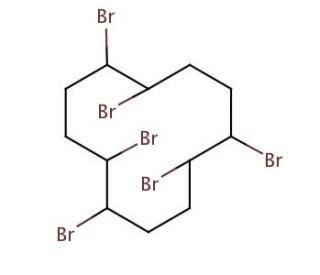

1,2,5,6,9,10-Hexabromocyclododecane (CAS 3194-55-6)
QUICK LINKS
1,2,5,6,9,10-Hexabromocyclododecane functions as a flame retardant in various experimental applications. It acts by interfering with the combustion process, inhibiting the spread of flames and reducing the risk of fire. At the molecular level, 1,2,5,6,9,10-Hexabromocyclododecane works by forming a protective layer on the surface of materials, preventing the ignition and propagation of fire. Its mode of action involves disrupting 1,2,5,6,9,10-Hexabromocyclododecane reactions involved in the combustion process, thereby reducing the flammability of the treated materials. 1,2,5,6,9,10-Hexabromocyclododecane′s function as a flame retardant is particularly relevant where the fire resistance of materials is a key consideration. It is used to enhance the safety and durability of various products and materials.
1,2,5,6,9,10-Hexabromocyclododecane (CAS 3194-55-6) References
- Modulation at a cellular level of the thyroid hormone receptor-mediated gene expression by 1,2,5,6,9,10-hexabromocyclododecane (HBCD), 4,4'-diiodobiphenyl (DIB), and nitrofen (NIP). | Yamada-Okabe, T., et al. 2005. Toxicol Lett. 155: 127-33. PMID: 15585367
- The stereochemistry of 1,2,5,6,9,10-hexabromocyclododecane and its graphic representation. | Becher, G. 2005. Chemosphere. 58: 989-91. PMID: 15639271
- Developmental toxicity of brominated flame retardants, tetrabromobisphenol A and 1,2,5,6,9,10-hexabromocyclododecane, in rat offspring after maternal exposure from mid-gestation through lactation. | Saegusa, Y., et al. 2009. Reprod Toxicol. 28: 456-67. PMID: 19577631
- Relevance of 1,2,5,6,9,10-hexabromocyclododecane diastereomer structure on partitioning properties, column-retention and clean-up procedures. | Mariussen, E., et al. 2010. J Chromatogr A. 1217: 1441-6. PMID: 20079498
- Preparation and X-ray structural characterization of further stereoisomers of 1,2,5,6,9,10-hexabromocyclododecane. | Riddell, N., et al. 2011. Chemosphere. 84: 900-7. PMID: 21724224
- The fate of β-hexabromocyclododecane in female C57BL/6 mice. | Sanders, JM., et al. 2013. Toxicol Sci. 134: 251-7. PMID: 23733921
- Increased cellular distribution of vimentin and ret in the cingulum of rat offspring after developmental exposure to decabromodiphenyl ether or 1,2,5,6,9,10-hexabromocyclododecane. | Fujimoto, H., et al. 2013. J Toxicol Pathol. 26: 119-29. PMID: 23914054
- The Simultaneous Determination of Six Flame Retardants in Water Samples Using SPE Pre-concentration and UHPLC-UV Method. | Kowalski, B. and Mazur, M. 2014. Water Air Soil Pollut. 225: 1866. PMID: 24672141
- [Substance monograph for 1,2,5,6,9,10-hexabromocyclododecane (HBCDD) - HBM levels for HBCDD in the fatty component of breast milk or of blood plasma : statement of the Human Biomonitoring Committee of the German Federal Environment Agency]. | . 2015. Bundesgesundheitsblatt Gesundheitsforschung Gesundheitsschutz. 58: 889-907. PMID: 26184837
- Hexabromocyclododecane (HBCD) in the Korean food basket and estimation of dietary exposure. | Barghi, M., et al. 2016. Environ Pollut. 213: 268-277. PMID: 26924755
- Transformation of hexabromocyclododecane in contaminated soil in association with microbial diversity. | Le, TT., et al. 2017. J Hazard Mater. 325: 82-89. PMID: 27915102
- Temporal Changes and Stereoisomeric Compositions of 1,2,5,6,9,10-Hexabromocyclododecane and 1,2-Dibromo-4-(1,2-dibromoethyl)cyclohexane in Marine Mammals from the South China Sea. | Ruan, Y., et al. 2018. Environ Sci Technol. 52: 2517-2526. PMID: 29397695
- Using high-throughput transcriptome sequencing to investigate the biotransformation mechanism of hexabromocyclododecane with Rhodopseudomonas palustris in water. | Wang, R., et al. 2019. Sci Total Environ. 692: 249-258. PMID: 31349166
- Migration of phenolic brominated flame retardants from contaminated food contact articles into food simulants and foods. | Paseiro-Cerrato, R., et al. 2021. Food Addit Contam Part A Chem Anal Control Expo Risk Assess. 38: 464-475. PMID: 33493090
Ordering Information
| Product Name | Catalog # | UNIT | Price | Qty | FAVORITES | |
1,2,5,6,9,10-Hexabromocyclododecane, 25 g | sc-222899 | 25 g | $46.00 |