
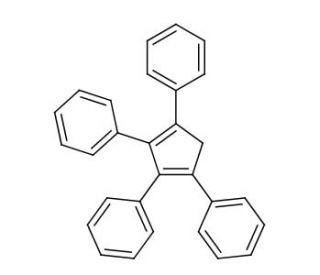

1,2,3,4-Tetraphenyl-1,3-cyclopentadiene (CAS 15570-45-3)
QUICK LINKS
1,2,3,4-Tetraphenyl-1,3-cyclopentadiene is a multi-phenylated version of cyclopentadiene, often utilized in materials science and organic chemistry research as a ligand or as a building block for the synthesis of larger, more complex organic molecules. The chemical′s rigid structure and conjugated system make it a subject of interest in the study of electron-rich aromatic systems, which are relevant for understanding the properties of conductive materials. In polymer science, this compound is explored for its potential to form polymers with unique optical and electronic properties, due to its ability to participate in various polymerization reactions. Its stability and bulky phenyl groups also make it a useful component in the study of steric effects in chemical reactions, providing insights into how such effects influence reactivity and selectivity. Additionally, 1,2,3,4-Tetraphenyl-1,3-cyclopentadiene is investigated in the field of organometallic chemistry, where it can act as a ligand to transition metals, thus aiding in the development of novel catalysts and coordination complexes with applications in synthesis and industry.
1,2,3,4-Tetraphenyl-1,3-cyclopentadiene (CAS 15570-45-3) References
- Rhodium-catalyzed oxidative coupling between salicylaldehydes and internal alkynes with C-H bond cleavage to produce 2,3-disubstituted chromones. | Shimizu, M., et al. 2008. Chem Asian J. 3: 881-6. PMID: 18386269
- Oxidative coupling of aromatic substrates with alkynes and alkenes under rhodium catalysis. | Satoh, T. and Miura, M. 2010. Chemistry. 16: 11212-22. PMID: 20740508
- Detecting topology freezing transition temperature of vitrimers by AIE luminogens. | Yang, Y., et al. 2019. Nat Commun. 10: 3165. PMID: 31320646
- Pressure-Induced Emission Enhancement and Multicolor Emission for 1,2,3,4-Tetraphenyl-1,3-cyclopentadiene: Controlled Structure Evolution. | Gu, Y., et al. 2019. J Phys Chem Lett. 10: 5557-5562. PMID: 31475532
- Highly fluorescent aryl-cyclopentadienyl ligands and their tetra-nuclear mixed metallic potassium-dysprosium clusters. | Arumugam, S., et al. 2020. RSC Adv. 10: 39366-39372. PMID: 35515404
- Origin of Nonmonotonical Variation of Luminescence Efficiency under Pressure in Organic Molecule. | Zeng, Y., et al. 2022. J Phys Chem A. 126: 4147-4155. PMID: 35749652
- Multiple responses of 1,6-diphenyl-1,3,5-hexatriene to mechanical stimulation: emission enhancement, piezochromism and negative linear compressibility. | Fu, Z., et al. 2023. Chem Sci. 14: 4817-4823. PMID: 37181776
- Formation of 1, 3, 4, 5-tetraphenyl-2, 6, 7-trioxabicyclo [3.2. 1] oct-3-ene from the ozonolysis of 1, 2, 3, 4-tetraphenyl-1, 3-cyclopentadiene. First [3+ 4] addition of a carbonyl oxide moiety to an. alpha.,. beta.-unsaturated carbonyl group | Mori, M., Nojima, M., & Kusabayashi, S. 1987. Journal of the American Chemical Society. 109(14): 4407-4408.
- Effect of electric field strength on the electroluminescence spectra of a blue-emitting device | Cao, H., Gao, X. C., Zhang, B. W., Zhai, J., Huang, C. H., & Cao, Y. 1998. Synthetic metals. 96(3): 191-194.
- Comparison of the electroluminescence and its related properties of two cyclopentadiene derivatives | Gao, X. C., Cao, H., Huang, L., Huang, Y. Y., Zhang, B. W., & Huang, C. H. 2003. Applied surface science. 210(3-4): 183-189.
- Synthesis, crystal Structures and aggregation-induced emission enhancement of aryl-substituted cyclopentadiene derivatives | Zhang, X., Ye, J., Xu, L., Yang, L., Deng, D., & Ning, G. 2013. Journal of luminescence. 139: 28-34.
- Rhodium-catalysed tandem dehydrogenative coupling–Michael addition: Direct synthesis of phthalides from benzoic acids and alkenes | Renzetti, A., Nakazawa, H., & Li, C. J. 2016. RSC advances. 6(47): 40626-40630.
- Efficient blue-emitting molecules by incorporating sulfur-containing moieties into triarylcyclopentadiene: Synthesis, crystal structures and photophysical properties | Ye, J., Gao, Y., He, L., Tan, T., Chen, W., Liu, Y.,.. & Ning, G. 2016. Dyes and Pigments. 124: 145-155.
Ordering Information
| Product Name | Catalog # | UNIT | Price | Qty | FAVORITES | |
1,2,3,4-Tetraphenyl-1,3-cyclopentadiene, 1 g | sc-251567 | 1 g | $124.00 |