
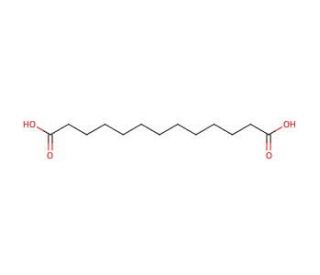

1,11-Undecanedicarboxylic acid (CAS 505-52-2)
QUICK LINKS
1,11-Undecanedicarboxylic acid occurs naturally as a dicarboxylic acid present in numerous plant species. As a C13 fatty acid, TDDA comprises 13 carbon atoms in its structure, with carboxylic acid groups located at the 1st and 13th carbon atoms. Given its distinct properties, 1,11 Undecanedicarboxylic acid finds wide-ranging applications in scientific research. In vitro studies employ TDDA in laboratory experiments to examine its impact on cells or other biological materials outside of living organisms. The precise mechanism of action of 1,11-Undecanedicarboxylic acid is not yet fully elucidated. However, it is hypothesized to operate through the modulation of several enzymes and proteins associated with inflammation and cell death.
1,11-Undecanedicarboxylic acid (CAS 505-52-2) References
- Feasibility of identifying the tobacco-related global metabolome in blood by UPLC-QTOF-MS. | Hsu, PC., et al. 2013. J Proteome Res. 12: 679-91. PMID: 23240883
- The metabolic analysis of psoriasis identifies the associated metabolites while providing computational models for the monitoring of the disease. | Ottas, A., et al. 2017. Arch Dermatol Res. 309: 519-528. PMID: 28695330
- Metabolomics Studies in Psoriatic Disease: A Review. | Koussiouris, J., et al. 2021. Metabolites. 11: PMID: 34200760
- Gut Microbiota and Serum Metabolic Signatures of High-Fat-Induced Bone Loss in Mice. | Lu, L., et al. 2021. Front Cell Infect Microbiol. 11: 788576. PMID: 35004355
- Multi-omics Analysis Revealed Coordinated Responses of Rumen Microbiome and Epithelium to High-Grain-Induced Subacute Rumen Acidosis in Lactating Dairy Cows. | Mu, Y., et al. 2022. mSystems. 7: e0149021. PMID: 35076273
- Lipidomic Profiling in Synovial Tissue. | Coras, R., et al. 2022. Front Med (Lausanne). 9: 857135. PMID: 35492314
- Improvement in Mung Bean Peptide on High-Fat Diet-Induced Insulin Resistance Mice Using Untargeted Serum Metabolomics. | Li, L., et al. 2022. Front Nutr. 9: 893270. PMID: 35571892
- Alterations of Gut Microbiome and Metabolite Profiles Associated With Anabatic Lipid Dysmetabolism in Thyroid Cancer. | Lu, G., et al. 2022. Front Endocrinol (Lausanne). 13: 893164. PMID: 35721748
- Metabolic Profiling in Rheumatoid Arthritis, Psoriatic Arthritis, and Psoriasis: Elucidating Pathogenesis, Improving Diagnosis, and Monitoring Disease Activity. | Dorochow, E., et al. 2022. J Pers Med. 12: PMID: 35743709
- Regulatory Effect of Mung Bean Peptide on Prediabetic Mice Induced by High-Fat Diet. | Li, L., et al. 2022. Front Nutr. 9: 913016. PMID: 35757244
- Metabonomic Analysis of Metabolites Produced by Escherichia coli in Patients With and Without Sepsis. | Wang, Y., et al. 2022. Infect Drug Resist. 15: 7339-7350. PMID: 36536860
- Mechanism of crocin I on ANIT-induced intrahepatic cholestasis by combined metabolomics and transcriptomics. | Song, D., et al. 2022. Front Pharmacol. 13: 1088750. PMID: 36744213
- Alterations of phenotype, physiology, and functional substances reveal the chilling-tolerant mechanism in two common Olea Europaea cultivars. | Jiang, C., et al. 2023. Front Plant Sci. 14: 1046719. PMID: 36818865
Ordering Information
| Product Name | Catalog # | UNIT | Price | Qty | FAVORITES | |
1,11-Undecanedicarboxylic acid, 5 g | sc-255890 | 5 g | $82.00 |