
Date published: 2026-7-28

1-800-457-3801

SCBT Portrait Logo
Seach Input

Vgl-1 Antibody (NQ-A1): sc-135601

4.0(2)
Write a reviewAsk a question

Datasheets
  • Vgl-1 Antibody (NQ-A1) is a mouse monoclonal IgG1 κ Vgl-1 antibody provided at 100 µg/ml
  • raised against recombinant Vgl-1 protein of human origin
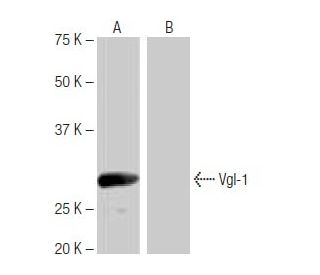
  • recommended for detection of Vgl-1 of human origin by WB, IP and ELISA
  • At present, we have not yet completed the identification of the preferred secondary detection reagent(s) for Vgl-1 Antibody (NQ-A1). This work is in progress.
    Gene Editing Promo Banner

    QUICK LINKS

    SEE ALSO...

    Vgl-1 Antibody (NQ-A1) is a mouse monoclonal IgG1 kappa light chain antibody that detects Vgl-1 protein of human origin by western blotting (WB), immunoprecipitation (IP), and enzyme-linked immunosorbent assay (ELISA). Anti-Vgl-1 antibody (NQ-A1) is available as a non-conjugated format. The vestigial-like protein 1 (Vgl-1), also known as TONDU or TDU, plays a pivotal role as a transcription cofactor within the transcriptional enhancer factor-1 (TEF-1) family, which is essential for regulating tissue-specific gene expression, particularly in muscle and placenta. The interaction between Vgl-1 and TEF-1 is mediated through a conserved sequence known as the TONDU (TDU) motif, which is crucial for the activation of tissue-specific genes. Notably, Vgl-1 is predominantly expressed in the placenta of adult human tissues, but Vgl-1 expression is more widespread in embryonic tissues, including the kidney, lung, skeletal muscle, heart, and placenta, highlighting Vgl-1′s importance during development. With a length of 258 amino acids, Vgl-1 is localized in the nucleus, where Vgl-1 exerts regulatory functions. Vgl-1′s ability to interact with specific cofactors underscores Vgl-1′s significance in the precise control of gene expression, making Vgl-1 a valuable target for research in developmental biology and related fields.

    For Research Use Only. Not Intended for Diagnostic or Therapeutic Use.

    Alexa Fluor® is a trademark of Molecular Probes Inc., OR., USA

    LI-COR® and Odyssey® are registered trademarks of LI-COR Biosciences

    Vgl-1 Antibody (NQ-A1) References:

    1. TONDU (TDU), a novel human protein related to the product of vestigial (vg) gene of Drosophila melanogaster interacts with vertebrate TEF factors and substitutes for Vg function in wing formation.  |  Vaudin, P., et al. 1999. Development. 126: 4807-16. PMID: 10518497
    2. Mammalian vestigial-like 2, a cofactor of TEF-1 and MEF2 transcription factors that promotes skeletal muscle differentiation.  |  Maeda, T., et al. 2002. J Biol Chem. 277: 48889-98. PMID: 12376544
    3. Transcription enhancer factor 1 binds multiple muscle MEF2 and A/T-rich elements during fast-to-slow skeletal muscle fiber type transitions.  |  Karasseva, N., et al. 2003. Mol Cell Biol. 23: 5143-64. PMID: 12861002
    4. VITO-1, a novel vestigial related protein is predominantly expressed in the skeletal muscle lineage.  |  Mielcarek, M., et al. 2002. Mech Dev. 119 Suppl 1: S269-74. PMID: 14516696
    5. Vgl-4, a novel member of the vestigial-like family of transcription cofactors, regulates alpha1-adrenergic activation of gene expression in cardiac myocytes.  |  Chen, HH., et al. 2004. J Biol Chem. 279: 30800-6. PMID: 15140898
    6. The transcriptional co-activator TAZ interacts differentially with transcriptional enhancer factor-1 (TEF-1) family members.  |  Mahoney, WM., et al. 2005. Biochem J. 388: 217-25. PMID: 15628970
    7. MCAT elements and the TEF-1 family of transcription factors in muscle development and disease.  |  Yoshida, T. 2008. Arterioscler Thromb Vasc Biol. 28: 8-17. PMID: 17962623

    Ordering Information

    Product NameCatalog #UNITPriceQtyFAVORITES

    Vgl-1 Antibody (NQ-A1)

    sc-135601
    100 µg/ml
    $339.00
