
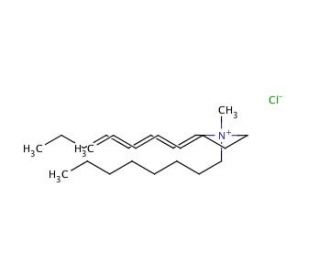

Tricaprylylmethylammonium chloride (CAS 63393-96-4)
QUICK LINKS
Tricaprylylmethylammonium chloride, an alkyl ammonium salt, plays a pivotal role in numerous scientific applications. With its significance in organic synthesis, it serves as a compound for the production of diverse organic substances. Furthermore, tricaprylylmethylammonium chloride finds extensive use in research endeavors encompassing biochemistry, physiology, and pharmacology. Its utilization spans investigations into cell membrane permeability, protein-lipid interactions, and membrane transporters. Additionally, it has proven valuable in the exploration of enzyme kinetics, drug metabolism, and receptor-ligand interactions. Studies involving gene expression, signal transduction, and cell signaling have also harnessed the capabilities of tricaprylylmethylammonium chloride. As an amphiphilic molecule, it engages with both hydrophobic and hydrophilic constituents of cell membranes. By binding to hydrophobic regions and being drawn to negatively charged components, its positive charge allows for modulating membrane permeability and influencing the activity of membrane proteins.
Tricaprylylmethylammonium chloride (CAS 63393-96-4) References
- Cloud-point extraction and preconcentration of cyanobacterial toxins (microcystins) from natural waters using a cationic surfactant. | Man, BK., et al. 2002. Environ Sci Technol. 36: 3985-90. PMID: 12269752
- Heterogeneous catalytic degradation of cyanide using copper-impregnated pumice and hydrogen peroxide. | Kitis, M., et al. 2005. Water Res. 39: 1652-62. PMID: 15878038
- Solid-state nanostructured materials from self-assembly of a globular protein-polymer diblock copolymer. | Thomas, CS., et al. 2011. ACS Nano. 5: 5697-707. PMID: 21696135
- Improved Synthesis of 1-O-Acyl-β-d-Glucopyranose Tetraacetates. | Chen, Y., et al. 2017. Molecules. 22: PMID: 28430152
- Recycling of zinc ions in disc-donut column considering forward mixing mass transfer, and effects of pulsed and non-pulsed condition. | Asadollahzadeh, M., et al. 2022. Sci Rep. 12: 1609. PMID: 35102211
- Deep Eutectic Solvent as Green Solvent in Extraction of Biological Macromolecules: A Review. | Ling, JKU. and Hadinoto, K. 2022. Int J Mol Sci. 23: PMID: 35328803
- Synthesis of high drug loading, reactive oxygen species and esterase dual-responsive polymeric micelles for drug delivery. | Wang, N., et al. 2019. RSC Adv. 9: 2371-2378. PMID: 35520478
- On the Use of Polymer Inclusion Membranes for the Selective Separation of Pb(II), Cd(II), and Zn(II) from Seawater. | Macías, M. and Rodríguez de San Miguel, E. 2023. Membranes (Basel). 13: PMID: 37233573
- Changes in transfer ribonucleic acids accompanying encystment in Acanthamoeba castellanii. | McMillen, J., et al. 1974. J Bacteriol. 117: 242-51. PMID: 4808904
- A new chromatographic system for increased resolution of transfer ribonucleic acids. | Weiss, JF. and Kelmers, AD. 1967. Biochemistry. 6: 2507-13. PMID: 4862273
- Ion exchanger modified PVC membranes--selectivity studies and response amplification of oxalate and lactate enzyme electrodes. | Reddy, SM. and Vadgama, PM. 1997. Biosens Bioelectron. 12: 1003-12. PMID: 9451790
Ordering Information
| Product Name | Catalog # | UNIT | Price | Qty | FAVORITES | |
Tricaprylylmethylammonium chloride, 250 ml | sc-255687 | 250 ml | $58.00 |