
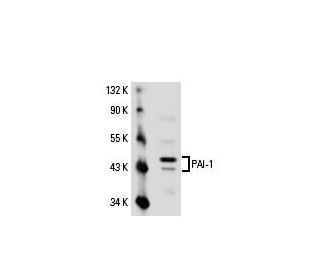


PAI-1/SERPINE1 Antibody (3A120): sc-59633
- PAI-1/SERPINE1 Antibody (3A120) is a mouse monoclonal IgG, cited in 7 publications, provided at 100 µg/ml
- raised against full length PAI-1 of human origin
- recommended for detection of both free and complexed forms of PAI-1 of human origin by WB, IP and ELISA
- See PAI-1/SERPINE1 (C-9): sc-5297 for PAI-1/SERPINE1 antibody conjugates, including AC, HRP, FITC, PE, Alexa Fluor® 488, 594, 647, 680 and 790.
- At present, we have not yet completed the identification of the preferred secondary detection reagent(s) for PAI-1/SERPINE1 Antibody (3A120). This work is in progress.

PAI-1 Antibody (3A120) is a mouse monoclonal IgG antibody that detects plasminogen activator inhibitor-1 (PAI-1) in human samples through applications such as western blotting (WB), immunoprecipitation (IP), and enzyme-linked immunosorbent assay (ELISA). PAI-1 plays a crucial role in regulating fibrinolysis by inhibiting urokinase-type plasminogen activator (uPA) and tissue plasminogen activator (tPA), which are essential for the conversion of plasminogen to plasmin, a key enzyme in the breakdown of fibrin in blood clots. The regulation of these proteolytic activities is vital for maintaining hemostatic balance and preventing excessive bleeding or thrombosis. PAI-1 is predominantly secreted by endothelial cells and is found in both the extracellular matrix and circulation, where PAI-1 can influence various physiological and pathological processes, including wound healing, tissue remodeling, and cancer metastasis. Notably, PAI-1 exists in both active and latent forms, with the latent form being a stable, inactive state that can be converted back to its active form under certain conditions, highlighting the dynamic regulation of PAI-1 activity. Anti-PAI-1 antibody (3A120) is an invaluable tool for researchers studying the intricate mechanisms of fibrinolysis and its implications in various diseases.
Alexa Fluor® is a trademark of Molecular Probes Inc., OR., USA
LI-COR® and Odyssey® are registered trademarks of LI-COR Biosciences
PAI-1/SERPINE1 Antibody (3A120) References:
- PAI-1, progress in understanding the clinical problem and its aetiology. | Iwaki, T., et al. 2012. Br J Haematol. 157: 291-8. PMID: 22360729
- PAI-1 inhibition by simvastatin as a positive adjuvant in cell therapy. | de Faria, CA., et al. 2019. Mol Biol Rep. 46: 1511-1517. PMID: 30612281
- PAI-1 augments mucosal damage in colitis. | Kaiko, GE., et al. 2019. Sci Transl Med. 11: PMID: 30842312
- Targeting PAI-1 in Cardiovascular Disease: Structural Insights Into PAI-1 Functionality and Inhibition. | Sillen, M. and Declerck, PJ. 2020. Front Cardiovasc Med. 7: 622473. PMID: 33415130
- Role of PAI-1 in hepatic steatosis and dyslipidemia. | Levine, JA., et al. 2021. Sci Rep. 11: 430. PMID: 33432099
- PAI-1 production by reactive astrocytes drives tissue dysfibrinolysis in multiple sclerosis models. | Lebas, H., et al. 2022. Cell Mol Life Sci. 79: 323. PMID: 35633384
- PAI-1 is a potential transcriptional silencer that supports bladder cancer cell activity. | Furuya, H., et al. 2022. Sci Rep. 12: 12186. PMID: 35842542
- PAI-1 Overexpression in Valvular Interstitial Cells Contributes to Hypofibrinolysis in Aortic Stenosis. | Kopytek, M., et al. 2023. Cells. 12: PMID: 37408236
- Critical roles of PAI-1 in lipopolysaccharide-induced acute lung injury. | Li, M., et al. 2024. Adv Med Sci. 69: 90-102. PMID: 38387409
- PAI-1 Regulates the Cytoskeleton and Intrinsic Stiffness of Vascular Smooth Muscle Cells. | Khoukaz, HB., et al. 2024. Arterioscler Thromb Vasc Biol. 44: 2191-2203. PMID: 38868940
Ordering Information
| Product Name | Catalog # | UNIT | Price | Qty | FAVORITES | |
PAI-1/SERPINE1 Antibody (3A120) | sc-59633 | 100 µg/ml | $322.00 |