
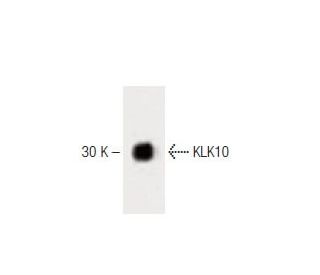

KLK10 Antibody (2): sc-135961
- KLK10 Antibody (2) is a mouse monoclonal IgG1 provided at 50 µg/0.5 ml
- raised against amino acids 99-202 of KLK10 of human origin
- recommended for detection of KLK10 of human origin by WB and IP
- At present, we have not yet completed the identification of the preferred secondary detection reagent(s) for KLK10 Antibody (2). This work is in progress.

KLK10 Antibody (2) is a mouse monoclonal IgG1 antibody that detects KLK10 in human samples through applications such as western blotting (WB) and immunoprecipitation (IP). KLK10, a member of the kallikrein family, plays a significant role in various physiological processes, including the regulation of blood pressure and inflammation, by cleaving specific peptide substrates. This serine protease is primarily expressed in the prostate and has been implicated in the development of prostate cancer, making anti-KLK10 antibody (2) a critical tool for cancer diagnostics and therapeutic strategies. The protein′s structure is characterized by a serine protease domain, which is essential for its enzymatic activity, and its proper folding and post-translational modifications, such as glycosylation, are crucial for stability and function. Dysregulation of KLK10 expression has been associated with tumor progression, highlighting its potential as a biomarker for cancer diagnosis and prognosis. KLK10 monoclonal antibody (2) provides a valuable tool for researchers investigating the role of this protease in cancer biology and other related fields.
Alexa Fluor® is a trademark of Molecular Probes Inc., OR., USA
LI-COR® and Odyssey® are registered trademarks of LI-COR Biosciences
KLK10 Antibody (2) References:
- Kallikrein 10 (KLK10) methylation as a novel prognostic biomarker in early breast cancer. | Kioulafa, M., et al. 2009. Ann Oncol. 20: 1020-5. PMID: 19150938
- NES1/KLK10 gene represses proliferation, enhances apoptosis and down-regulates glucose metabolism of PC3 prostate cancer cells. | Hu, J., et al. 2015. Sci Rep. 5: 17426. PMID: 26616394
- KLK10 exon 3 unmethylated PCR product concentration: a new potential early diagnostic marker in ovarian cancer? - A pilot study. | El Sherbini, MA., et al. 2018. J Ovarian Res. 11: 32. PMID: 29690914
- NES1/KLK10 and hNIS gene therapy enhanced iodine-131 internal radiation in PC3 proliferation inhibition. | Hu, J., et al. 2019. Front Med. 13: 646-657. PMID: 31119602
- Kallikrein-related peptidase (KLK10) cessation blunts colorectal cancer cell growth and glucose metabolism by regulating the PI3K/Akt/mTOR pathway. | Wei, H., et al. 2020. Neoplasma. 67: 889-897. PMID: 32386481
- Transcriptional Suppression of miR-7 by MTA2 Induces Sp1-Mediated KLK10 Expression and Metastasis of Cervical Cancer. | Lin, CL., et al. 2020. Mol Ther Nucleic Acids. 20: 699-710. PMID: 32402941
- MiR-194-3p modulates the progression of colorectal cancer by targeting KLK10. | Liu, T. and Fang, Y. 2022. Histol Histopathol. 37: 301-309. PMID: 34935123
- Prospective quantitative gene expression analysis of kallikrein-related peptidase KLK10 as a diagnostic biomarker for childhood acute lymphoblastic leukemia. | Ahmad, SM., et al. 2022. PeerJ. 10: e13489. PMID: 35669967
- miR-194-3p represses the docetaxel resistance in colon cancer by targeting KLK10. | Zhao, J., et al. 2022. Pathol Res Pract. 236: 153962. PMID: 35691099
- LRG1 promotes the apoptosis of pulmonary microvascular endothelial cells through KLK10 in chronic obstructive pulmonary disease. | Cheng, W., et al. 2024. Tob Induc Dis. 22: PMID: 38707515
Ordering Information
| Product Name | Catalog # | UNIT | Price | Qty | FAVORITES | |
KLK10 Antibody (2) | sc-135961 | 50 µg/0.5 ml | $322.00 |