
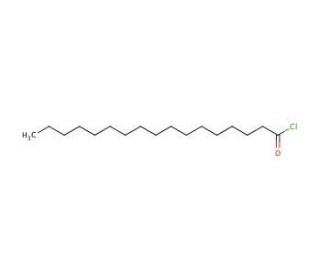

Heptadecanoyl chloride (CAS 40480-10-2)
QUICK LINKS
Heptadecanoyl chloride, a long-chain fatty acid chloride, plays a pivotal role in research focused on organic synthesis and surface modification. As an acylating agent, it is instrumental in creating heptadecanoate esters and amides, facilitating the attachment of a hydrophobic C17 chain to various substrates. This reactivity enables it to modify natural and synthetic polymers, enhancing their water resistance, thermal stability, and mechanical properties. For instance, in modifying cellulose and other biopolymers, heptadecanoyl chloride imparts significant hydrophobicity, making it valuable in studying the development of biodegradable coatings, adhesives, and packaging materials. Furthermore, in surface chemistry, heptadecanoyl chloride is crucial for creating self-assembled monolayers (SAMs) on metal and silicon substrates. Its long-chain structure forms densely packed films, which are vital for understanding surface interactions, wettability, and adhesion. These SAMs are used extensively in the study of anti-corrosive coatings, lubrication, and the modification of surface energy. In chemical synthesis, this compound is also utilized for developing fatty acid derivatives for studying lipid metabolism and the role of long-chain fatty acids in biological systems. Overall, its versatility in acylation and surface engineering provides a foundation for comprehensive studies in polymer science, materials research, and organic chemistry.
Heptadecanoyl chloride (CAS 40480-10-2) References
- Identification, isolation and characterization of impurities of clindamycin palmitate hydrochloride. | Bharathi, Ch., et al. 2008. J Pharm Biomed Anal. 48: 1211-8. PMID: 18947955
- A liquid chromatography-tandem mass spectrometry method for measurement of N-modified phosphatidylethanolamines. | Guo, L., et al. 2010. Anal Biochem. 405: 236-45. PMID: 20599652
- Effect of dietary krill oil supplementation on the endocannabinoidome of metabolically relevant tissues from high-fat-fed mice. | Piscitelli, F., et al. 2011. Nutr Metab (Lond). 8: 51. PMID: 21749725
- Mimicking the lipid peroxidation inhibitory activity of phospholipid hydroperoxide glutathione peroxidase (GPx4) by using fatty acid conjugates of a water-soluble selenolane. | Iwaoka, M., et al. 2015. Molecules. 20: 12364-75. PMID: 26198222
- Impact of the multiscale viscoelasticity of quasi-2D self-assembled protein networks on stem cell expansion at liquid interfaces. | Kong, D., et al. 2022. Biomaterials. 284: 121494. PMID: 35413511
- N-Acylation of ethanolamine phospholipids by acyl transfer does not involve hydrolysis. | Schmid, PC. and Schmid, HH. 1987. Biochim Biophys Acta. 922: 398-400. PMID: 3689820
- Hydrolysis of N-acylated glycerophospholipids by phospholipases A2 and D: a method of identification and analysis. | Schmid, PC., et al. 1986. Chem Phys Lipids. 41: 195-207. PMID: 3815621
- Long-chain and very long-chain methyl-branched alcohols and their acetate esters in pupae of the tobacco hornworm, Manduca sexta. | Nelson, and Dennis R., et al. 1990. Insect biochemistry. 20.8: 809-819.
- Synthesis, characterization, Langmuir–Blodgett film deposition and non-linear optical properties of a series of new non-linear optical materials based on azo dyes containing europium complex anions. | Li, Hui, et al. 1995. Journal of Materials Chemistry. 5.11: 1871-1878.
- A sensitive and selective method for the quantitative determination of fatty acid tryptamides as shell indicators in cocoa products. | Münch, et al. 1999. Zeitschrift für Lebensmitteluntersuchung und-Forschung A. 208: 39-46.
Ordering Information
| Product Name | Catalog # | UNIT | Price | Qty | FAVORITES | |
Heptadecanoyl chloride, 100 mg | sc-211581 | 100 mg | $35.00 | |||
Heptadecanoyl chloride, 1 g | sc-211581A | 1 g | $145.00 |