
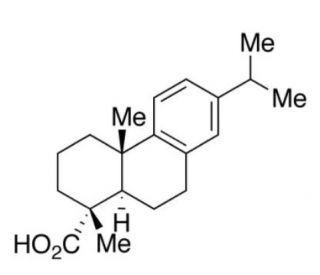

Dehydroabietic acid (CAS 1740-19-8)
See product citations (3)
QUICK LINKS
Dehydroabietic acid (DHA) is a diterpenoid acid that occurs naturally in various plant species, including conifers, and is utilized in the synthesis of pharmaceuticals and other industrial products. Dehydroabietic acid has been the subject of extensive research due to its biological, biochemical, and physiological effects. It is believed to regulate the activity of several enzymes, such as cytochrome P450s and other xenobiotic metabolizing enzymes. Furthermore, Dehydroabietic acid has been demonstrated to impact the activity of cytokines, inflammatory mediators, and the renin-angiotensin system. In vitro studies involving cell culture systems have examined the effects of Dehydroabietic acid on cell proliferation, apoptosis, and gene expression. In vivo studies have involved animal models to explore the impact of Dehydroabietic acid on the cardiovascular and immune systems, as well as its potential to modulate inflammation.
Dehydroabietic acid (CAS 1740-19-8) References
- Bioconversion of ecotoxic dehydroabietic acid using Rhodococcus actinobacteria. | Cheremnykh, KM., et al. 2018. J Hazard Mater. 346: 103-112. PMID: 29253749
- Dehydroabietic Acid Suppresses Inflammatory Response Via Suppression of Src-, Syk-, and TAK1-Mediated Pathways. | Kim, E., et al. 2019. Int J Mol Sci. 20: PMID: 30934981
- Genome of Tripterygium wilfordii and identification of cytochrome P450 involved in triptolide biosynthesis. | Tu, L., et al. 2020. Nat Commun. 11: 971. PMID: 32080175
- Dehydroabietic acid alleviates high fat diet-induced insulin resistance and hepatic steatosis through dual activation of PPAR-γ and PPAR-α. | Xie, Z., et al. 2020. Biomed Pharmacother. 127: 110155. PMID: 32413669
- Antihypertensive Effects of Dehydroabietic and 4-Epi-Trans-Communic Acid Isolated from Pinus densiflora. | Park, J., et al. 2021. J Med Food. 24: 50-58. PMID: 33449861
- Dehydroabietic acid improves nonalcoholic fatty liver disease through activating the Keap1/Nrf2-ARE signaling pathway to reduce ferroptosis. | Gao, G., et al. 2021. J Nat Med. 75: 540-552. PMID: 33590347
- Dehydroabietic Acid Is a Novel Survivin Inhibitor for Gastric Cancer. | Kim, WJ., et al. 2021. Plants (Basel). 10: PMID: 34067279
- Water-in-Oil Emulsion Gels Stabilized by a Low-Molecular Weight Organogelator Derived from Dehydroabietic Acid. | Pang, S., et al. 2022. Langmuir. 38: 6049-6056. PMID: 35507678
- Synthesis and Antiproliferative Activity of Novel Dehydroabietic Acid-Chalcone Hybrids. | Grigoropoulou, S., et al. 2022. Molecules. 27: PMID: 35684559
- Design, synthesis and biological evaluation of dehydroabietic acid derivative as potent vasodilatory agents. | Wu, D., et al. 2022. Bioorg Chem. 129: 106110. PMID: 36087551
- Recent Advances on Biological Activities and Structural Modifications of Dehydroabietic Acid. | Hao, M., et al. 2022. Toxins (Basel). 14: PMID: 36136570
- Effects of dehydroabietic acid on nontarget lipidomics and proteomics of HepG2. | Xiahou, Z. and Han, J. 2022. Front Pharmacol. 13: 1015240. PMID: 36532744
Ordering Information
| Product Name | Catalog # | UNIT | Price | Qty | FAVORITES | |
Dehydroabietic acid, 1 mg | sc-499572B | 1 mg | $220.00 | |||
Dehydroabietic acid, 50 mg | sc-499572C | 50 mg | $311.00 | |||
Dehydroabietic acid, 100 mg | sc-499572 | 100 mg | $402.00 | |||
Dehydroabietic acid, 250 mg | sc-499572A | 250 mg | $703.00 | |||
Dehydroabietic acid, 500 mg | sc-499572D | 500 mg | $1510.00 | |||
Dehydroabietic acid, 1 g | sc-499572E | 1 g | $2498.00 |