
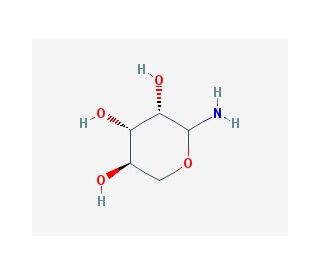

D-Lyxosylamine 의 분자 구조, CAS 번호: 39840-37-4
D-Lyxosylamine (CAS 39840-37-4)
CAS 등록번호:
39840-37-4
분자량:
149.15
분자식:
C5H11NO4
연구용으로만 사용가능합니다. 진단이나 치료용으로 사용불가합니다.
* Refer to Certificate of Analysis for lot specific data.
빠른 링크
주문정보
설명
기술정보
안전정보
SDS 및 분석 증명서
D-리코오스의 유도체인 D-리소실아민은 탄수화물 화학 및 당생물학에서의 잠재적 응용 가능성으로 인해 과학 연구에서 주목을 받고 있습니다. 이 물질의 작용 메커니즘은 주로 구조적으로 다양한 탄수화물 유도체 합성을 위한 전구체로서의 역할과 관련이 있습니다. 화학자들은 글리코사이드, 글리코콘쥬게이트, 글리코모메틱 합성의 빌딩 블록으로 D-리소실아민을 활용합니다. 글리코실화 반응 및 유도체화 전략과 같은 다양한 화학적 변형을 통해 D-리코소실아민은 맞춤형 구조와 기능을 가진 새로운 탄수화물 기반 화합물을 만들 수 있습니다. 또한 연구자들은 글리칸-단백질 상호작용, 세포 표면 인식, 탄수화물 대사를 포함한 탄수화물 매개 생물학적 과정을 연구하는 데 이 물질을 활용하고 있습니다. 과학자들은 D-리소실아민을 합성 경로에 통합함으로써 생물학적 시스템에서 특정 탄수화물의 역할을 설명하고 당생물학적 현상을 조사하기 위한 새로운 도구를 개발하는 것을 목표로 합니다. 또한, D-리소실아민은 당과학 연구에서 효소 메커니즘과 억제제 설계를 조사하는 데 유용한 도구로 사용됩니다. 전반적으로 D-리소실아민은 화학 생물학에서 생체 재료 과학에 이르기까지 다양한 분야에서 탄수화물의 기능과 그 응용에 대한 이해를 발전시키는 데 중요한 역할을 합니다.
D-Lyxosylamine (CAS 39840-37-4) 참고자료
- 새로운 항암제를 찾는 중입니다. XXIII: N-니트로소클로로에틸아미노, N-니트로소메틸, N-니트로소아미녹실 성분을 함유한 탄수화물의 항암제 예측 설계 탐색. | Sosnovsky, G. and Rao, NU. 1991. J Pharm Sci. 80: 693-9. PMID: 1658297
- 허브 포고스테모니스 물 추출물의 구성 및 선천성 면역 세포 자극에 의한 살모넬라 타이피무륨 유발 간 손상 및 사망으로부터 감염된 생쥐를 보호합니다. | Kim, SP., et al. 2012. J Agric Food Chem. 60: 12122-30. PMID: 23186318
- 마크로라이드 항생제에 대한 효소 면역 분석: 23-아미노-O-마이카미노실틸로놀라이드에 대한 항체의 특성 분석. | Yao, RC. and Mahoney, DF. 1989. Appl Environ Microbiol. 55: 1507-11. PMID: 2764563
- 선천성 지카 감염 신생아에 대한 표적화되지 않은 대사체학 인사이트. | Nunes, EDC., et al. 2021. Pathogens. 10: PMID: 33924291
- 실험적 괴사성 췌장염에서 장내 미생물의 공간적 지역 평가. | van den Berg, FF., et al. 2021. BJS Open. 5: PMID: 34518874
- 정맥모래파리의 다양한 조직에서 탄수화물 결합 특이성과 렉틴의 물리화학적 특성. | Palánová, L. and Volf, P. 1997. Folia Parasitol (Praha). 44: 71-6. PMID: 9188176
- 당류 물질의 2차 비선형 광학적 특성[C] | Bourhill G, Mansour K, Perry K J,. 1993,. Organic and Biological Optoelectronics. SPIE,. 1853: 110-125.
- GC-MS 선택 이온 모니터링을 사용한 '의사' 표적 방법에 의한 상업용 담배의 화학적 특성 조사[J]. | Li Y, Pang T, Li Y. 2013,. Journal of separation science,. 36(9-10): 1545-1552.
- 광합성 Synechocystis sp. PCC 6803[J]에서 부탄올 내성의 실험실 진화에 대한 대사체학 기반. | Wang Y, Shi M, Niu X,. 2014. Microbial Cell Factories,. 13: 1-12.
- GC/MS 기반 대사체학 접근법을 통한 첫물 찻잎 대사산물에 대한 그늘-그늘 없음 상태 및 후속 농약 처리 평가[J]. | Ray S, Chatterjee J, Ghosh A. 2021. Cogent Food & Agriculture,. 7(1): 1930424.
주문정보
| 제품명 | 카탈로그 번호 | 단위 | 가격 | 수량 | 관심품목 | |
D-Lyxosylamine, 5 g | sc-221497 | 5 g | $380.00 |