


CLK4 더블 틈내기효소 플라스미드 (h): sc-404084-NIC
- Target species: human
- 20 µg of transfection-ready, purified plasmid DNA; Suitable for up to 20 transfections
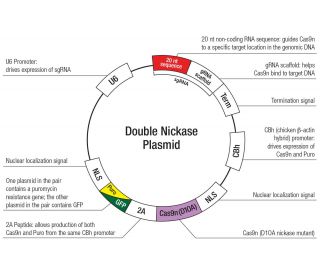
- CLK4 Double Nickase Plasmid (h) 는 한쌍의D10A mutated Cas9 nuclease 와 타깃특정 20 nt guide RNA (gRNA)를 인코딩하는 plasmid를 포함하고있으며 gRNA는 대응 CRISPR/Cas9 KO보다 높은 특이성을 띤 knockout gene을 발현하도록 디자인되였습니다.
- 한쌍의 gRNA는 약 20bp가량 떨어져 있으며 이는 게놈DNA의 Cas9-mediated double nicking을 발생하여 DSB를 모방합니다.
- 한쌍의 plasmid 중 하나는 selection에 필요한 puromycin-resistance gene을, 다른하나는 형질주입효율을 확인하는 GFP marker를 보유하고있습니다.
- CLK4 더블 니케이스 플라스미드 (h) 및 CLK4 더블 니케이스 플라스미드 (h2)는 CLK4을 표적하는 서로 다른 쌍을 이루는 gRNA 설계를 암호화합니다. 하나 또는 두 가지 디자인 모두 이용 가능할 수 있습니다

주문정보
| 제품명 | 카탈로그 번호 | 단위 | 가격 | 수량 | 관심품목 | |
CLK4 더블 틈내기효소 플라스미드 (h) | sc-404084-NIC | 20 µg | $410.00 | |||
CLK4 더블 틈내기효소 플라스미드 (h2) | sc-404084-NIC-2 | 20 µg | $410.00 |
CDC 유사 키나아제 4(CDC-like kinase 4, CLK4)는 이중 특이성 단백질 키나아제로서 세린/아르지닌-풍부(SR) 스플라이싱 인자들을 인산화하며, 신호 전달 입력을 스플라이스좀 조립 및 대체 pre-mRNA 스플라이싱 결정과 연결한다. SR 단백질의 인산화 역학을 조절함으로써 CLK4는 mRNA 가공, 전사–스플라이싱 연계, 그리고 세포주기 진행과 스트레스 적응성 유전자 발현을 형성하는 보다 광범위한 RNA 대사 프로그램에 기여한다. CLK 계열의 활성이 비정상적으로 조절되면 스플라이싱 패턴이 변화하여 종양성 신호 네트워크, DNA 손상 반응, 분화 상태에 영향을 줄 수 있으므로, CLK4는 스플라이싱 연관 표현형의 기전 연구에서 중요한 노드로 간주된다. 따라서 인간 CLK4는 전사체 아이소폼 전환과 키나아제 조절 스플라이싱 제어가 질병 관련 세포 행동의 핵심이 되는 맥락에서 자주 연구된다.
CLK4 더블 니카제 플라스미드(h)는 human 세포주 내 CLK4 유전자좌의 고특이성 편집을 위해 설계된 쌍을 이루는 플라스미드로 구성됩니다. 각 플라스미드는 Cas9 D10A 니카아제와 CLK4 내의 반대 DNA 가닥을 표적으로 하는 고유한 sgRNA를 발현합니다. 반대 DNA 가닥의 인접 부위로 유도될 때, 두 니카아제는 서로 어긋난 단일 가닥 절단 부위를 생성하며, 이는 함께 엇갈린 이중 가닥 절단을 유발하여 두 가이드의 조화된 표적 활성을 필요로 합니다. 이렇게 생성된 DNA 절단은 내인성 세포 복구 경로, 특히 비동형 말단 결합(NHEJ)을 통해 해결되며, 이는 CLK4의 기능을 방해하는 삽입 또는 결실을 초래한다. 표적 부위에서 이중 sgRNA 결합을 요구함으로써, 이중 니킹 접근법은 편집 특이성을 향상시키고 표적 정밀도에 대한 추가적인 제어가 필요한 응용을 위한 보완적인 CRISPR 전략을 제공한다.
편집된 세포를 효율적으로 식별할 수 있도록, 한 플라스미드는 형광 시각화를 위한 GFP를 발현하며, 다른 플라스미드는 항생제 선별을 위한 푸로마이신 내성 유전자를 포함하고 있습니다. 이러한 기능들은 공동 형질 도입된 세포 집단의 효율적인 농축을 지원하며, CLK4 기능이 손상된 클론의 검증을 단순화합니다.
연구용으로만 사용하세요. 진단 또는 치료용이 아닙니다.