
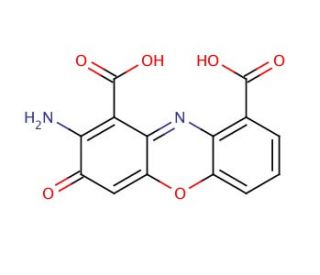

Molecular structure of Cinnabarinic Acid, CAS Number: 606-59-7
Cinnabarinic Acid (CAS 606-59-7)
Alternate Names:
2-Amino-3-oxo-3H-phenoxazine-1,9-dicarboxylic Acid
Application:
Cinnabarinic Acid is a mGlu4 receptor agonist
CAS Number:
606-59-7
Purity:
≥95%
Molecular Weight:
300.22
Molecular Formula:
C14H8N2O6
For Research Use Only. Not Intended for Diagnostic or Therapeutic Use.
* Refer to Certificate of Analysis for lot specific data.
QUICK LINKS
Ordering Information
Description
Technical Information
Safety Information
SDS & Certificate of Analysis
Cinnabarinic Acid is a red pigmented phenoxazinone derivative that may act to posses strong apoptosis-inducing activity in thymocytes. Mechanistic studies show that this compound results in the production of reactive oxygen species (ROS) and causes loss of mitochondrial membrane potential and reduces caspase activation. Additional experiments show that Cinnabarinic Acid is capable of completely inhibiting mitochondrial respiratory control. Cinnabarinic acid is also a mGluR-4 agonist and in studies of transiently transfected HEK 293 cells, Cinnabarinic acid acitvates mGluR-4 and is selective over all other types (mGluR-1, mGluR-2, mGluR-5-8).
Cinnabarinic Acid (CAS 606-59-7) References
- Cinnabarinic acid was formed in damaged mitochondria and its effect on mitochondrial respiration. | Nagamura, Y., et al. 1999. Adv Exp Med Biol. 467: 419-23. PMID: 10721084
- Oxidation of 3-hydroxyanthranilic acid to the phenoxazinone cinnabarinic acid by peroxyl radicals and by compound I of peroxidases or catalase. | Christen, S., et al. 1992. Biochemistry. 31: 8090-7. PMID: 1324727
- ENZYMIC CONVERSION OF 3-HYDROXYANTHRANILIC ACID INTO CINNABARINIC ACID BY THE NUCLEAR FRACTION OF RAT LIVER. | SUBBARAO, PV., et al. 1965. Biochem J. 95: 628-32. PMID: 14342496
- Cinnabarinic acid generated from 3-hydroxyanthranilic acid strongly induces apoptosis in thymocytes through the generation of reactive oxygen species and the induction of caspase. | Hiramatsu, R., et al. 2008. J Cell Biochem. 103: 42-53. PMID: 17476692
- Cinnabarinic acid, an endogenous agonist of type-4 metabotropic glutamate receptor, suppresses experimental autoimmune encephalomyelitis in mice. | Fazio, F., et al. 2014. Neuropharmacology. 81: 237-43. PMID: 24565643
- Aryl hydrocarbon receptor-dependent stanniocalcin 2 induction by cinnabarinic acid provides cytoprotection against endoplasmic reticulum and oxidative stress. | Joshi, AD., et al. 2015. J Pharmacol Exp Ther. 353: 201-12. PMID: 25672339
- Cinnabarinic acid and xanthurenic acid: Two kynurenine metabolites that interact with metabotropic glutamate receptors. | Fazio, F., et al. 2017. Neuropharmacology. 112: 365-372. PMID: 27342123
- The Trace Kynurenine, Cinnabarinic Acid, Displays Potent Antipsychotic-Like Activity in Mice and Its Levels Are Reduced in the Prefrontal Cortex of Individuals Affected by Schizophrenia. | Ulivieri, M., et al. 2020. Schizophr Bull. 46: 1471-1481. PMID: 32506121
- Cinnabarinic Acid-Induced Stanniocalcin 2 Confers Cytoprotection against Alcohol-Induced Liver Injury. | Joshi, AD., et al. 2022. J Pharmacol Exp Ther. 381: 1-11. PMID: 35078862
- Unstability of cinnabarinic acid, an endogenous metabolite of tryptophan, under situations mimicking physiological conditions. | Gómez-Piñeiro, RJ., et al. 2022. Biochimie. 199: 150-157. PMID: 35469990
- nzymic conversion of 3-hydroxyanthranilic acid into cinnabarinic acid. Partial purification and properties of ra-liver cinnabarinate synthase. | Rao, PV. and Vaidyanahan, CS. 1966. Biochem J. 99: 317-22. PMID: 5944241
- Cinnabarinic acid formation in Malpighian tubules of the silkworm, Bombyx mori. Participation of catalase in cinnabarinic acid formation in the presence of manganese ion. | Ogawa, H., et al. 1983. Hoppe Seylers Z Physiol Chem. 364: 1059-66. PMID: 6629330
- Laccase-mediated formation of the phenoxazinone derivative, cinnabarinic acid. | Eggert, C., et al. 1995. FEBS Lett. 376: 202-6. PMID: 7498542
Activator of:
mGluR-4.Ordering Information
| Product Name | Catalog # | UNIT | Price | Qty | FAVORITES | |
Cinnabarinic Acid, 2.5 mg | sc-211094 | 2.5 mg | $202.00 |