
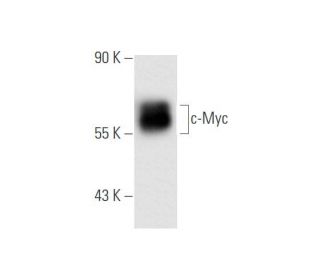
c-Myc 항체(1.N.2): sc-70469. HeLa 전체 세포 용해물에서 c-Myc 발현의 웨스턴 블롯 분석.
Myc 항체 (1.N.2): sc-70469
- Myc 항체(1.N.2) 는 마우스 monoclonal IgG1κ, 16간행물에 인용, 이며 200 µg/ml으로 제공합니다.
- human의 전체 길이 재조합 c-Myc에 대해 제기됨
- WB, IP와 IF으로 mouse, rat, human와 avian origin의 c-Myc p67 and c-Myc tagged fusion proteins을 검출할것을 권장합니다.
- See Myc (9E10): sc-40 for additional antibody conjugates, including AC, HRP, FITC, PE, Alexa Fluor® 488, 594, 647, 680 and 790.
- m-IgGκ BP-HRP는 Myc 항체 (1.N.2) WB 애플리케이션용입니다. 이 시약은 현재 Myc 항체 (1.N.2)(아래 주문 정보 참조)와 함께 번들로 제공됩니다. 추가 m-IgGκ BP 접합체는 마우스 IgG 결합 단백질 전체 목록을 참조하세요.

세포 증식, 분화 및 종양 질환에서 c-Myc, N-Myc 및 L-Myc로 코딩된 단백질이 기능합니다. 폐암, 유방암, 대장암을 비롯한 여러 유형의 인간 종양에서 c-Myc 유전자의 증폭이 발견되었습니다. 류신 지퍼, 나선-루프-나선 및 기본 영역을 포함한 세 가지 서열 모티프가 c-Myc COOH 말단에 존재하는 것은 서열 특이적 결합 기능에 대한 초기 증거를 제공했습니다. Max로 지정된 기본 영역 나선 루프 헬릭스 류신 지퍼 모티프(bHLH-Zip) 단백질은 c-Myc, N-Myc 및 L-Myc 단백질과 특이적으로 결합합니다. Myc-Max 복합체는 Max나 Myc가 눈에 띄는 결합을 보이지 않는 조건에서 서열 특이적인 방식으로 DNA에 결합합니다. Max는 또한 최소 두 개의 추가 bHLH-Zip 단백질인 Mad 1 및 Mxi1과 헤테로다이머를 형성할 수 있으며, Mad 1-Max 다이머는 mSin3와의 상호 작용을 통해 전사를 억제하는 것으로 나타났습니다.
연구용으로만 사용가능합니다. 진단이나 치료용으로 사용불가합니다.
Alexa Fluor®는 미국 오리건주 Molecular Probes Inc.의 상표입니다.
LI-COR®와 Odyssey®는 LI-COR Biosciences의 등록 상표입니다.
Myc 항체 (1.N.2) 참고문헌:
- c-Myc 조절 microRNA는 E2F1 발현을 조절합니다. | O'Donnell, KA., et al. 2005. Nature. 435: 839-43. PMID: 15944709
- 리보솜 생성과 암에서 c-Myc와 리보솜 사이의 교차. | Dai, MS. and Lu, H. 2008. J Cell Biochem. 105: 670-7. PMID: 18773413
- 뉴클레오포스민은 c-Myc 핵 국소화 및 c-Myc 매개 rDNA 전사에 필수적입니다. | Li, Z. and Hann, SR. 2013. Oncogene. 32: 1988-94. PMID: 22665062
- c-Myc는 Drosha의 전사 조절을 통해 microRNA 처리를 조절합니다. | Wang, X., et al. 2013. Sci Rep. 3: 1942. PMID: 23735886
- c-MYC 프로모터 G-쿼드러플렉스에 결합하고 c-MYC 발현을 하향 조절하는 댄실-구아노신 형광성 복합체. | Pavan Kumar, Y., et al. 2016. Chembiochem. 17: 388-93. PMID: 26708259
- 듀비퀴티나아제 USP38은 c-Myc를 안정화하여 세포 증식을 촉진합니다. | Xu, Z., et al. 2021. Int J Biochem Cell Biol. 137: 106023. PMID: 34102342
- HELZ2는 망막아세포종 종양 발생을 유도하기 위해 c-Myc의 K63-연결 폴리유비퀴틴화를 촉진합니다. | Dai, H., et al. 2021. Med Oncol. 39: 11. PMID: 34761308
- Trovafloxacin, Ozanimod, Ozenoxacin을 강력한 c-Myc G-쿼드러플렉스 안정제로 확인하여 c-Myc 전사와 골수종 성장을 억제합니다. | Zhang, J., et al. 2022. Mol Inform. 41: e2200011. PMID: 35355429
- c-Myc 전사와 골수종 성장을 억제하기 위해 c-Myc G-쿼드러플렉스를 표적으로 하는 Licoflavone B와 Ginkgetin의 구조 기반 발견. | Liu, L., et al. 2022. Chem Biol Drug Des. 100: 525-533. PMID: 35557489
- FIT는 대장암 발병 과정에서 RBBP7을 모집함으로써 c-Myc와 P53의 아세틸화를 연결합니다. | Guo, L., et al. 2023. Cancer Gene Ther. 30: 1124-1133. PMID: 37225855
주문정보
| 제품명 | 카탈로그 번호 | 단위 | 가격 | 수량 | 관심품목 | |
Myc 항체 (1.N.2) | sc-70469 | 200 µg/ml | $322.00 | |||
Myc (1.N.2): m-IgGκ BP-HRP 번들 | sc-552808 | 200 µg Ab; 40 µg BP | $361.00 |