
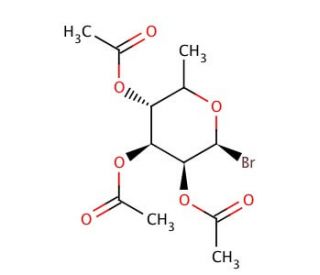

Acetobromofucose (CAS 16741-27-8)
QUICK LINKS
Acetobromofucose is a synthetic derivative of fucose, a deoxy sugar, wherein an acetate group replaces the hydroxyl group, and a bromo group is introduced, enhancing its electrophilic character. This modification makes it a key reagent in the field of carbohydrate chemistry, particularly useful for glycosylation reactions where it acts as a glycosyl donor. The presence of the bromo group in Acetobromofucose allows it to participate in nucleophilic substitution reactions, making it highly reactive and suitable for forming glycosidic bonds under controlled conditions. The acetate group serves as a protecting group, stabilizing the sugar ring during chemical reactions and preventing unwanted side reactions. This property is crucial for synthesizing complex oligosaccharides with specific and controlled architectures. In research, Acetobromofucose is extensively used to study and develop new methodologies for the synthesis of glycoconjugates, which are compounds where sugars are linked to other functional groups or molecules. These studies are pivotal for advancing our understanding of glycan structures and their biological functions. Moreover, its application in synthetic chemistry allows for the exploration of biochemical pathways and the development of biomimetic materials, contributing to a deeper understanding of biological recognition and interaction mechanisms. This makes Acetobromofucose a valuable tool in academic and industrial research settings focused on the fundamental aspects of glycoscience.
Acetobromofucose (CAS 16741-27-8) References
- A highly convergent and effective synthesis of the phytoalexin elicitor hexasaccharide. | Wang, W. and Kong, F. 1999. Carbohydr Res. 315: 117-27. PMID: 10385974
- Nitrosation of sugar oximes: preparation of 2-glycosyl-1-hydroxydiazene-2-oxides. | Brand, J., et al. 2005. Chemistry. 12: 499-509. PMID: 16224758
- Synthesis and evaluation of antimicrobial activity of some pyrimidine glycosides. | El-Sayed, HA., et al. 2008. Nucleosides Nucleotides Nucleic Acids. 27: 1061-71. PMID: 18711668
- Copper(II) and zinc(II) complexes with C-glycoside-pendant dipicolylamine (DPA)-amino acid conjugates. | Mikata, Y., et al. 2009. Dalton Trans. 10305-10. PMID: 19921066
- Monogalactopyranosides of fluorescein and fluorescein methyl ester: synthesis, enzymatic hydrolysis by biotnylated β-galactosidase, and determination of translational diffusion coefficient. | Mandal, PK., et al. 2012. Carbohydr Res. 358: 40-6. PMID: 22817995
- An efficient method for the synthesis of pyranoid glycals. | Chen, H., et al. 2016. Carbohydr Res. 431: 42-6. PMID: 27295068
- A reinvestigation of the condensation reaction of acetobromoglucose with chloromercuri-4-ethoxy-2(1H)-pyrimidinone to 1-(tetra-O-acetyl-beta-D-glucopyranosyl)-4-ethoxy-2(1H)-pyrimidinone. | Ukita, T., et al. 1963. Chem Pharm Bull (Tokyo). 11: 1068-73. PMID: 5888553
- Synthesis of the methyl thioglycosides of 2-, 3-, and 4-deoxy-L-fucose. | Hasegawa, A., et al. 1994. Carbohydr Res. 257: 55-65. PMID: 8004639
- Cerebroside analogues from 3-phenylserines. | Weiss, B. 1977. Chem Phys Lipids. 19: 347-55. PMID: 908106
- Synthesis of glycosides in which the aglycon is an N-(hydroxymethyl)amino-1,3,5-triazine derivative. | Bagga, K., et al. 1997. Glycoconj J. 14: 519-21. PMID: 9249153
Ordering Information
| Product Name | Catalog # | UNIT | Price | Qty | FAVORITES | |
Acetobromofucose, 2.5 g | sc-214463 | 2.5 g | $2540.00 |