
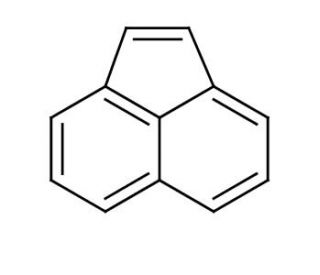

Acenaphthylene (CAS 208-96-8)
QUICK LINKS
Acenaphthylene, a polycyclic aromatic hydrocarbon (PAH), its unique structure consisting of fused benzene rings, which enables it to fluoresce under ultraviolet light. This property is particularly valued in analytical chemistry for studying the degradation pathways of PAHs, enhancing our understanding of their stability and reactivity under various environmental conditions. Its role in dye production involves complex chemical transformations that help develop compounds with desired properties such as enhanced colorfastness and resistance to environmental degradation. Acenaphthylene′s chemical structure aim to improve material durability and efficacy. Acenaphthylene interactions involving Acenaphthylene during these processes typically include electrophilic substitution and coupling reactions, for modifying electronic properties that dictate the behavior of the resulting materials in their respective applications.
Acenaphthylene (CAS 208-96-8) References
- Reactions of hydroxyl radicals and ozone with acenaphthene and acenaphthylene. | Reisen, F. and Arey, J. 2002. Environ Sci Technol. 36: 4302-11. PMID: 12387402
- Novel intermediates of acenaphthylene degradation by Rhizobium sp. strain CU-A1: evidence for naphthalene-1,8-dicarboxylic acid metabolism. | Poonthrigpun, S., et al. 2006. Appl Environ Microbiol. 72: 6034-9. PMID: 16957226
- Metabolism of acenaphthylene via 1,2-dihydroxynaphthalene and catechol by Stenotrophomonas sp. RMSK. | Nayak, AS., et al. 2009. Biodegradation. 20: 837-43. PMID: 19543983
- Unexpected σ bond rupture during the reaction of N-methyl-1,2,4-triazoline-3,5-dione with acenaphthylene and indene. | Breton, GW., et al. 2014. J Org Chem. 79: 8212-20. PMID: 25084364
- Oxidation of Acenaphthene and Acenaphthylene by Human Cytochrome P450 Enzymes. | Shimada, T., et al. 2015. Chem Res Toxicol. 28: 268-78. PMID: 25642975
- Metal-Catalyzed C-H Bond Activation of 5-Membered Carbocyclic Rings: A Powerful Access to Azulene, Acenaphthylene and Fulvene Derivatives. | Shi, X., et al. 2018. Chem Asian J. 13: 143-157. PMID: 29105311
- Rhodium-Catalyzed Asymmetric [2 + 2 + 2] Cycloaddition of Unsymmetrical α,ω-Diynes with Acenaphthylene. | Aida, Y., et al. 2018. J Org Chem. 83: 2617-2626. PMID: 29345935
- Alternated biodegradation of naphthalene (NAP), acenaphthylene (ACY) and acenaphthene (ACE) in an aerobic granular sludge reactor (GSBR). | Ofman, P., et al. 2020. J Hazard Mater. 383: 121184. PMID: 31522063
- Photomechanochemical control over stereoselectivity in the [2 + 2] photodimerization of acenaphthylene. | Biswas, S., et al. 2023. Faraday Discuss. 241: 266-277. PMID: 36134559
- Synthetic Doping of Acenaphthylene through BN/CC Isosterism and a Direct Comparison with BN-Acenaphthene. | Zhang, Y., et al. 2022. J Org Chem. 87: 12986-12996. PMID: 36149831
- Formation of the acenaphthylene cation as a common C2H2-loss fragment in dissociative ionization of the PAH isomers anthracene and phenanthrene. | Banhatti, S., et al. 2022. Phys Chem Chem Phys. 24: 27343-27354. PMID: 36326610
- Selective photodimerization of acenaphthylene in polymersome nanoreactors. | Rijpkema, SJ., et al. 2023. Chem Commun (Camb). 59: 4782-4785. PMID: 37000591
- Aryl hydrocarbon (Ah) receptor-independent induction of Cyp1a2 gene expression by acenaphthylene and related compounds in B6C3F1 mice. | Chaloupka, K., et al. 1994. Carcinogenesis. 15: 2835-40. PMID: 8001243
Ordering Information
| Product Name | Catalog # | UNIT | Price | Qty | FAVORITES | |
Acenaphthylene, 100 mg | sc-239181 | 100 mg | $146.00 |