
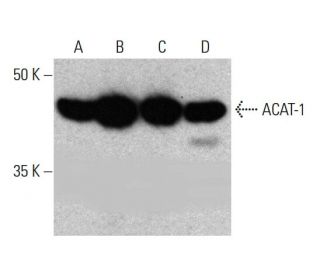

ACAT-1 Antibody (AT15E5): sc-517387
- ACAT-1 Antibody (AT15E5) is a mouse monoclonal IgG1 κ ACAT-1 antibody provided at 100 µg/ml
- raised against a recombinant protein corresponding to amino acids 34-427 of ACAT-1 of human origin
- recommended for detection of ACAT-1 of human origin by WB, IP, IF and ELISA
- At present, we have not yet completed the identification of the preferred secondary detection reagent(s) for ACAT-1 Antibody (AT15E5). This work is in progress.

QUICK LINKS
ACAT-1 Antibody (AT15E5) is a mouse monoclonal IgG1 kappa light chain antibody that detects ACAT-1 protein of human origin by western blotting (WB), immunoprecipitation (IP), immunofluorescence (IF), and enzyme-linked immunosorbent assay (ELISA). Anti-ACAT-1 antibody (AT15E5) is available as a non-conjugated format. ACAT-1 protein, also known as acetyl-Coenzyme A acetyltransferase 1, is a crucial mitochondrial enzyme that plays a significant role in ketone body metabolism and isoleucine processing. ACAT-1 protein is located within mitochondria, where ACAT-1 facilitates acetyl-CoA conversion into acetoacetyl-CoA, a key step in ketone body synthesis and degradation. ACAT-1′s mitochondrial localization is important for regulating energy metabolism, particularly during fasting or low carbohydrate intake, when ketone bodies serve as an alternative energy source for brain and heart tissues. Deficiencies in ACAT-1 can lead to serious metabolic disorders, including β-ketothiolase deficiency, characterized by ketoacidotic attacks. Additionally, ACAT-2, a cytosolic counterpart, is vital for cholesterol synthesis, highlighting these enzymes′ interconnected roles in lipid metabolism.
Alexa Fluor® is a trademark of Molecular Probes Inc., OR., USA
LI-COR® and Odyssey® are registered trademarks of LI-COR Biosciences
ACAT-1 Antibody (AT15E5) References:
- Identification, purification and characterization of an acetoacetyl-CoA thiolase from rat liver peroxisomes. | Antonenkov, VD., et al. 2000. Eur J Biochem. 267: 2981-90. PMID: 10806397
- Immunological quantitation and localization of ACAT-1 and ACAT-2 in human liver and small intestine. | Chang, CC., et al. 2000. J Biol Chem. 275: 28083-92. PMID: 10846185
- Phylogenetic analysis of the thiolase family. Implications for the evolutionary origin of peroxisomes. | Igual, JC., et al. 1992. J Mol Evol. 35: 147-55. PMID: 1354266
- High resolution crystal structures of human cytosolic thiolase (CT): a comparison of the active sites of human CT, bacterial thiolase, and bacterial KAS I. | Kursula, P., et al. 2005. J Mol Biol. 347: 189-201. PMID: 15733928
- Phylogenetic analysis of eukaryotic thiolases suggests multiple proteobacterial origins. | Peretó, J., et al. 2005. J Mol Evol. 61: 65-74. PMID: 15980957
- Human urotensin II accelerates foam cell formation in human monocyte-derived macrophages. | Watanabe, T., et al. 2005. Hypertension. 46: 738-44. PMID: 16172428
- Inborn errors of isoleucine degradation: a review. | Korman, SH. 2006. Mol Genet Metab. 89: 289-99. PMID: 16950638
- Crystallographic and kinetic studies of human mitochondrial acetoacetyl-CoA thiolase: the importance of potassium and chloride ions for its structure and function. | Haapalainen, AM., et al. 2007. Biochemistry. 46: 4305-21. PMID: 17371050
- Expression of two isozymes of acyl-coenzyme A: cholesterol acyltransferase-1 and -2 in clear cell type renal cell carcinoma. | Matsumoto, K., et al. 2008. Int J Urol. 15: 166-70. PMID: 18269457
- Rat liver peroxisomes catalyze the initial step in cholesterol synthesis. The condensation of acetyl-CoA units into acetoacetyl-CoA. | Thompson, SL. and Krisans, SK. 1990. J Biol Chem. 265: 5731-5. PMID: 1969406
- ACAT-1-Regulated Cholesteryl Ester Accumulation Modulates Gemcitabine Resistance in Biliary Tract Cancer. | Ueno, G., et al. 2022. Ann Surg Oncol. 29: 2899-2909. PMID: 34994902
- Assignment of the human cytosolic acetoacetyl-coenzyme A thiolase (ACAT2) gene to chromosome 6q25.3-q26. | Masuno, M., et al. 1996. Genomics. 36: 217-8. PMID: 8812443
Ordering Information
| Product Name | Catalog # | UNIT | Price | Qty | FAVORITES | |
ACAT-1 Antibody (AT15E5) | sc-517387 | 100 µg/ml | $322.00 |